In tarot, the Five of Wands represents clashing ambitions, petty rivalry, and the friction that happens when many individual wills pull in different directions at once. It is an image of noisy competition and uncoordinated energy—rarely malicious, but full of daily disagreement.
What does the Five of Wands mean upright?
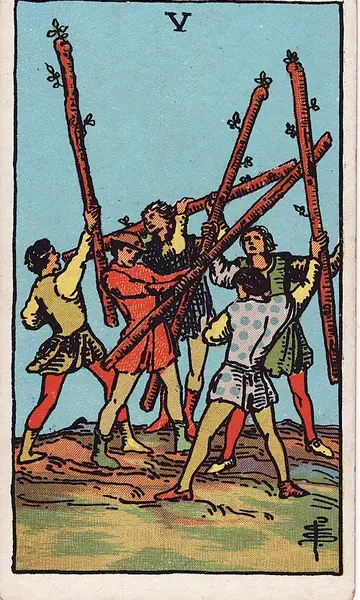
When the Five of Wands appears upright, it points to a situation charged with competition, clashing egos, and chaotic teamwork. Everyone wants their voice heard, yet nobody is pausing to orchestrate the effort.
Arthur Edward Waite described this card as a mock fight, capturing the strenuous competition of life in pursuit of personal gain. It rarely signals genuine hatred or permanent damage. Instead, think of it as athletic friction: a sparring match that tests your stamina, challenges your patience, and sharpens your skills. The core advice of the card is to channel this disorganized tension into a fair contest governed by clear ground rules.
What does the Five of Wands mean reversed?
Reversed, the nature of the conflict shifts. In some situations, the friction finally eases, making room for compromise, active listening, and a return to cooperation.
In other cases, the struggle simply goes underground. Reversed, it can reflect avoided disputes, passive aggression, and unspoken resentment that nobody wants to address out loud. Waite associated the reversal with litigation, disputes, trickery, and contradiction. When you encounter this card upside down, pause and decide whether it is time to address the root issue directly or walk away from an unproductive contest.
How does the Five of Wands speak to love and relationships?
In relationship readings, the Five of Wands points to squabbles, bickering, and competing priorities. It reflects moments when both partners are fighting to prove a point rather than working to understand each other.
This card does not indicate deep hostility; it simply highlights day-to-day irritation. You might be negotiating domestic habits, schedules, or differing communication styles. When wills clash in this way, treating the disagreement as a shared problem to solve—rather than a battle to win—helps quiet the noise.
How does it apply to work and money?
In professional environments, the Five of Wands reflects chaotic teamwork, office politics, and healthy or intense competition. Projects may stall because team members are defending their turf instead of coordinating their talents. It asks you to focus on your own performance and advocate for clearer project structures.
Financially, this card reflects competitive markets, bidding wars, and price battles between rivals. When reversed, it points to financial disagreements that are either nearing a quiet settlement or escalating toward lawyers, formal arbitration, and drawn-out legal disputes.
Does the Five of Wands mean yes or no?
In a straightforward yes-or-no question, the Five of Wands reads as a no. It shows that too many competing opinions, obstacles, and conflicting interests are active right now to allow for a smooth, cohesive outcome.
What is pictured on the card and why?
In the Rider–Waite–Smith tradition (deck published in 1909), artist Pamela Colman Smith illustrated five young men brandishing wooden staves against one another under a clear blue sky.
Notice that none of the figures is actually striking another. The scene resembles a practice drill, a sport, or a mock battle rather than genuine violence. Their varied garments represent differing temperaments, worldviews, and personal motivations. The crossed staves demonstrate abundant vitality and passion that lack central coordination or shared direction.
What do the number and suit reveal about this card?
The suit of Wands governs career, ambition, creative drive, and action, carrying the dynamic quality of the Fire element.
In tarot numerology, the Fives break the calm stability established by the Fours. They introduce conflict, loss, instability, and necessary change. When the disruptive energy of a Five enters the ambitious world of Wands, it creates an explosion of active energy: multiple people fighting for the same spotlight or pushing competing visions forward.
What are the card’s astrological and esoteric correspondences?
Within the Hermetic Order of the Golden Dawn tradition, the Five of Wands carries the title “Lord of Strife.”
Its suit element is Fire, and its astrological decan attribution is Saturn in Leo. This pairing highlights the tension between Saturn—representing structure, limitation, and hard boundaries—and Leo, representing pride, creative expression, and personal ambition. The card illustrates what occurs when individual pride runs straight into external resistance.
Which cards interact with the Five of Wands?
When the Five of Wands appears alongside the Five of Swords, the energetic sparring shifts into open, bitter conflict. This combination warns of a fight where nobody truly wins, as petty arguments risk degenerating into hurtful behavior and lingering resentment.
What are common mistakes when reading the Five of Wands?
A frequent mistake is assuming the Five of Wands represents violence, serious hostility, or permanent enemies. It is fundamentally an image of rivalry, debate, and sport-like struggle rather than real enmity.
Another mistake is viewing the card as an entirely negative outcome. Friction can be productive: healthy debate often refines rough ideas, exposes weaknesses in a plan, and encourages everyone involved to raise their standard of work.
Try it yourself
- Where in my daily routine am I wasting energy arguing just to be right?
- How can I turn a chaotic disagreement at work into an organized, productive conversation?
- What boundaries do I need to establish so that healthy competition does not become personal friction?
- Am I facing an honest debate, or am I avoiding a dispute that needs to be addressed?