In tarot, The High Priestess represents hidden knowledge, the quiet inner voice, and the space between what is seen and what is felt. When she appears, she signals that not everything is out in the open yet, and that the answers you need will come from trusting your intuition and allowing stillness rather than forcing immediate action.
What does The High Priestess mean upright?
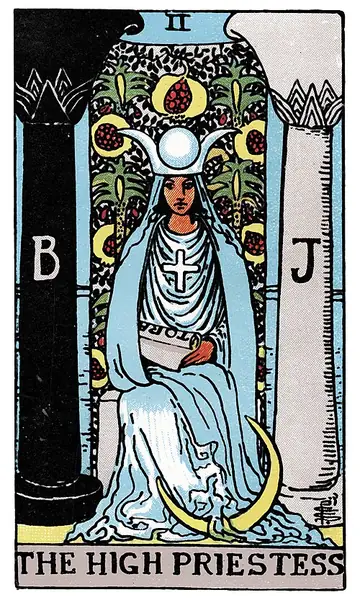
Upright, The High Priestess guards what is not yet said: unrevealed elements of a situation and knowledge that arises through quiet intuition rather than intellectual argument. In Arthur Edward Waite’s 1909 Rider–Waite–Smith tradition, she signifies secrets, mystery, silence, tenacity, and wisdom.
Her core advice is simple: be quiet long enough to hear what you already know. When this card appears in a reading, it counsels you to look inward. Rather than rushing into decisions or demanding immediate external clarity, step back. Some facts remain behind the veil, and practicing patience and active listening will reveal what logic alone cannot see.
What does The High Priestess reversed mean?
When reversed, The High Priestess suggests that your inner voice is being ignored or drowned out by external noise. It points to knowing only the surface of a situation, overlooking subtle cues, or having critical details concealed from you.
Waite read the reversal as passion, ardour, conceit, and surface knowledge. It can also point to feelings and instincts held down until they turn into restlessness, or the frustrating sense of being shut out from what others know. A reversed High Priestess invites you to examine where you might be dismissing your gut instincts or settling for shallow assumptions.
How does The High Priestess speak to love and relationships?
In love readings, The High Priestess points to unspoken depth. A relationship may carry intense emotional undercurrents, but something has not yet been told.
This does not automatically point to deceit or betrayal. Instead, it often means that feelings, vulnerabilities, or personal truths are still quietly developing beneath the surface. Rather than forcing rapid disclosures, allow the space for honesty and mutual understanding to unfold naturally.
How does The High Priestess apply to work and money?
At work, The High Priestess indicates that vital information remains hidden. You might sense shifting dynamics within a project or organization that have not yet been formally announced. Trust your gut, keep your own counsel, and wait for the complete picture to emerge before making decisive career moves.
Regarding money, not all information is on the table. This is a clear signal to pause, research, and look closely at the details before committing funds. Impulsive investments or hasty agreements are ill-advised when key data remains obscured.
Is The High Priestess a yes or a no?
The High Priestess answers with a “maybe.”
Because this card embodies unrevealed factors and evolving circumstances, the outcome is not yet fixed. Crucial elements remain behind the veil. Rather than seeking a quick binary answer, use this moment to pause, gather more information, and reflect on what your intuition is already sensing.
What is pictured on the card and why?
In the Rider–Waite–Smith deck, a veiled priestess sits between two pillars marked B and J, representing Boaz and Jachin. These pillars signify the fundamental dualities—light and dark, conscious and subconscious—which she holds in balance.
Behind her hangs a veil patterned with pomegranates, representing the mysteries not yet revealed to conscious awareness. In her lap rests a half-hidden scroll of the Tora, denoting sacred, concealed knowledge. At her feet lies a crescent moon, symbolizing her dominion over intuition, natural cycles, and the subconscious mind.
What are the esoteric correspondences of The High Priestess?
In the Hermetic Order of the Golden Dawn, The High Priestess carries the title The Priestess of the Silver Star.
Her astrological attribution is the Moon, connecting her to intuition, cycles, and reflection. The element Water is a modern convention derived from the Golden Dawn (attributing to a planet card the element of that planet), used primarily for evaluating elemental dignities between cards in a spread.
On the Tree of Life, she is attributed to the Hebrew letter Gimel (camel) and occupies Path 13: Kether-Tiphareth, connecting pure divine source with the seat of conscious harmony.
Which cards strengthen or change The High Priestess?
When paired with other cards, The High Priestess deepens the focus on the unseen:
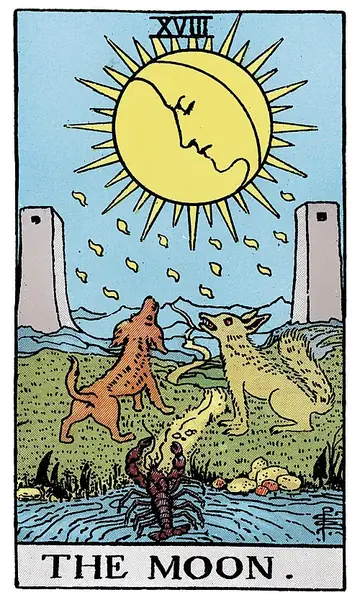
- The High Priestess + The Moon: Highlights strong intuition, but also deep illusion. While your inner senses are sharp, distortions can arise; verify the facts before placing complete trust.
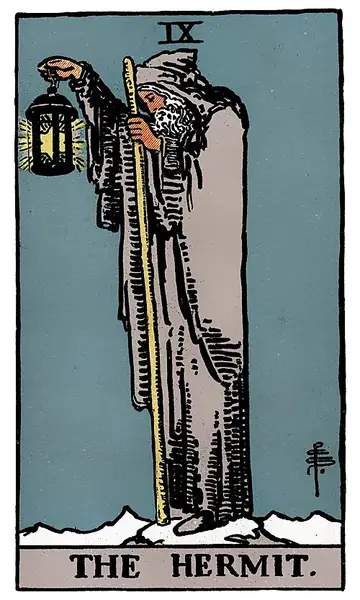
- The High Priestess + The Hermit: A powerful combination of quiet inner search and wisdom found in solitude. It indicates that meaningful answers will come from peaceful contemplation rather than outward pursuit.
What are the common misreadings of this card?
Two frequent misconceptions often arise when interpreting The High Priestess:
- Mistaking stillness for passivity: She does not represent indecision or helplessness. Her waiting is deliberate, disciplined, and grounded in active listening.
- Assuming a romantic rival: In relationship readings, readers often assume she represents an outside person or a hidden lover. First and foremost, read her as hidden knowledge and intuition before jumping to interpersonal drama.