At its heart, the Ten of Pentacles represents lasting wealth, family legacy, and established security. It marks a moment where ongoing material efforts settle into durable foundations, creating resources and stability that can support not just you, but also the people and generations that follow.
What does the upright Ten of Pentacles mean?
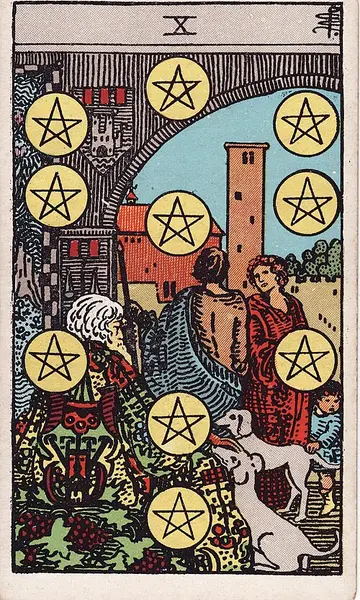
When upright, the Ten of Pentacles speaks to wealth that lasts: family, inheritance, tradition, and established security. In the Rider–Waite–Smith tradition, published in 1909, Arthur Edward Waite associated this card with gain, riches, family matters, archives, lineage, and the family home.
This card highlights the satisfaction of long-term planning and community roots. Rather than pointing toward quick profits or temporary triumphs, it invites you to look at what truly endures. It favors long-term stability, real property, and family support. The card’s core advice is straightforward: build for the long term and for those who come after.
What does the reversed Ten of Pentacles mean?
Reversed, the foundation cracks: the card indicates family disputes over money, inheritance quarrels, financial loss, or fragile security. Waite connected its reversed aspect to chance, loss, robbery, and games of hazard, noting that it can also involve issues surrounding a gift, dowry, or pension.
When this card turns upside down, it suggests that material stability is being tested by internal conflict or poor risk management. Risky bets, unclear boundaries around shared assets, or old family grievances can threaten what took years to assemble. The card encourages you to step back, avoid unnecessary gambles, and protect what is meant to be passed on.
What does the Ten of Pentacles mean in love and relationships?
In love, the Ten of Pentacles centers on long-term commitment and family. It reflects relationships that have moved beyond initial romance into deep structural partnership, shared domestic life, and mutual support across extended networks.
When this card appears in a relationship inquiry, it often indicates making joint commitments, purchasing a home together, or blending family traditions. If reversed, it can show that tensions over money, property, or differing expectations from extended relatives are putting strain on an otherwise solid partnership.
How does the Ten of Pentacles apply to work and money?
In work readings, the Ten of Pentacles points to an established business and long-term security. It can reflect reaching a senior milestone, joining a historic and stable institution, or managing a multigenerational family endeavor where procedures and reputations are firmly rooted.
Financially, this card is closely linked to lasting wealth, property, inheritance, or a resilient business model. Reversed, it serves as a warning against disputes over money, messy contractual disagreements, or jeopardizing steady assets through volatile investments.
Does the Ten of Pentacles read as a yes or a no?
The Ten of Pentacles reads as a yes. It reflects grounded structures, collective support, and outcomes designed to hold their value over time.
What is pictured on the card and why?
In the Rider–Waite–Smith illustration, an old man in a richly patterned cloak sits by an archway accompanied by two dogs. In the courtyard beyond him, a couple and a small child stand together, depicting three generations to show the continuous flow of security and kinship.
The stone archway, carved with a coat of arms, represents the family line, heritage, and the endurance of home. Suspended across the entire composition, ten pentacles are arranged in the geometry of the Kabbalistic Tree of Life. This arrangement emphasizes that true material abundance is structured, balanced, and deeply integrated into daily life.
What do its number and suit reveal?
The card belongs to the suit of Pentacles, which represents the element of Earth. This suit governs money, work, health, and material security—the tangible matters of the physical world.
Tens carry the meaning of completion, the end of a cycle, and the threshold where a new one begins. In the suit of Pentacles, the ten shows that the work of cultivating the physical world has reached its ultimate expression. The harvest is complete, leaving behind an established baseline that will sustain the start of the next cycle.
What are its esoteric correspondences?
In the Golden Dawn system (Book T), the Ten of Pentacles carries the title Lord of Wealth. Its suit element is Earth, grounding the card in tangible reality and physical form.
Its astrological correspondence is Mercury in Virgo, assigned to the final decan of the sign. In this placement, Mercury’s analytical and administrative abilities combine with Virgo’s meticulous, practical focus. This correspondence highlights that lasting security is rarely accidental; it relies on careful management, attention to daily systems, and diligent stewardship of resources.
Which cards strengthen or change the Ten of Pentacles?
Tarot cards influence one another in a spread to tell a nuanced story. When the Ten of Pentacles pairs with the Ace of Pentacles, it highlights an opportunity that builds lasting wealth.
In this combination, the Ace supplies the initial seed—a concrete new venture, contract, or financial beginning—while the Ten of Pentacles shows that this seed holds the potential to grow into durable, long-range security and community support.
What are common mistakes when reading this card?
A common mistake is assuming that the Ten of Pentacles applies only to very rich families or traditional dynasties. In practice, it represents stability and legacy in any form, including close-knit chosen families, community spaces, or reliable shared routines that keep people safe.
Another mistake is reading the card as emotional fulfillment. Emotional contentment and relational harmony belong to the Ten of Cups. The Ten of Pentacles is strictly concerned with material grounding, practical structures, and tangible continuity.
Try it yourself
- What kind of lasting security am I currently trying to build for myself and those around me?
- How can I better protect and organize the resources I have already accumulated?
- Where do my personal financial choices connect with or conflict with family traditions?
- What long-term legacy do I want my day-to-day work to support?