The Ten of Wands represents carrying too much: the heavy burden of responsibility when you are close to the finish line. It reflects overextension, showing how initial ambition and hard work can turn into stress and exhaustion when you try to handle every single task on your own.
What does the Ten of Wands mean upright?
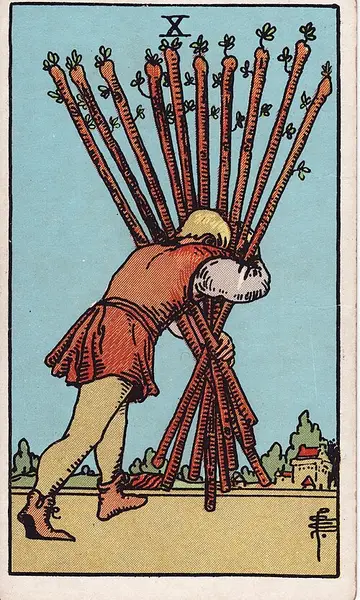
Upright, the Ten of Wands signals an overwhelming load of responsibility, hard work, and stress. It frequently appears when you are near the end of a long endeavor, indicating that you have taken on so many commitments that the sheer weight is beginning to obscure your path.
Arthur Edward Waite, co-creator of the Rider–Waite–Smith deck published in 1909, described this card as oppression, but also as fortune, gain, and success—followed by the oppression of those very achievements. Success naturally attracts more obligations, yet trying to shoulder everything without help leads straight to burnout. The card offers a moment to pause and assess your priorities. Its core advice is simple: put something down, because you do not have to carry it all. Take a realistic look at your obligations and decide what to delegate or refuse.
What does the Ten of Wands mean reversed?
When reversed, the card marks a point where the strain breaks: the load is either deliberately shed, or you collapse under its weight. In a healthy reading, the reversal represents conscious release. You choose to put down staves, say no, and delegate tasks to others. Real relief comes from letting go of what is not strictly yours to manage.
On the other hand, the reversal can warn of acute burnout or dropping things unintentionally because you waited too long to ask for help. Waite also associated the reversed card with contrarieties, difficulties, and intrigues that crop up when exhaustion compromises judgment. In either case, the card indicates that carrying this burden alone is no longer an option.
How does the Ten of Wands read in love and relationships?
In relationship readings, the Ten of Wands indicates that one partner carries too much. Whether it is emotional labor, daily logistics, or resolving conflicts, the balance of effort has become uneven.
When one person bears the brunt of holding the relationship together, affection easily turns into fatigue and quiet resentment. This card invites an honest conversation about sharing the load, inviting both people to rebalance their shared responsibilities.
What does the Ten of Wands mean for work and money?
In professional readings, the Ten of Wands points straight to overwork. You may be managing projects that started with great enthusiasm but have accumulated too many moving parts. The practical guidance is clear: work hard, but delegate. Continuing to micromanage every detail will only stall progress near the finish.
Financially, the card reflects heavy obligations or debts. It suggests steady, hard work to resolve commitments, but warns against trying to resolve financial pressure in isolation. Reversed, it points either to overdue relief from a financial burden or to exhaustion caused by overworking for material security.
Does the Ten of Wands read as a yes or a no?
The Ten of Wands reads as a no. It indicates that the path forward is currently weighed down by too many obligations and fatigue, suggesting that adding more to your plate now will lead to strain.
What is pictured on the card and why?
In the traditional Rider–Waite–Smith illustration, a figure bends under the weight of ten heavy wooden staves, carrying them toward a nearby town. The bundle completely hides the figure’s face.
Every element in Pamela Colman Smith’s 1909 illustration tells a psychological story. The heavy bundle represents success that has become a burden through accumulation. The figure’s blocked view demonstrates how overload hides the goal and blinds you to the bigger picture. Meanwhile, the town in the background shows that the destination is actually nearby. The finish is in sight, provided you do not let the final stretch break your spirit.
What do the suit of Wands and the number ten reveal?
The suit of Wands centers on career, ambition, creative drive, and action. It reflects our capacity to channel vitality and enthusiasm into concrete projects.
The number ten signifies completion, the end of a cycle, and a new one beginning. In the sequence of Wands, the creative fire that began in the Ace has reached its absolute limit of density. Ambition has carried the project as far as it can go on solitary willpower. Reaching the number ten shows that this way of working must conclude, clearing space for a more sustainable cycle.
What are the astrological and esoteric correspondences?
The Ten of Wands belongs to the suit element of Fire, which governs willpower, passion, and energy under pressure.
In the Golden Dawn tradition, this card carries the title “Lord of Oppression.” Its astrological correspondence is Saturn in Sagittarius. This decan attribution sets the restrictive discipline and heaviness of Saturn against the expansive, forward-moving optimism of Sagittarius, illustrating what happens when limitless ambition becomes bound by heavy duty.
How does the Fire of Wands combine with other elements?
When read alongside other cards, the Fire of the Ten of Wands interacts through elemental dynamics:
With Earth cards, the intense physical toil of Fire meets material reality. Earth can help organize the workload into manageable systems, though it can also make obligations feel rigid and immovable.
With Air cards, intellect meets action. Air can offer practical perspective to analyze which tasks to drop, but an overload of Air can fan the flames into mental anxiety and overthinking.
With Water cards, inner emotions meet outer effort. Water cools the heat of exhaustion and calls for emotional rest, though unexpressed feelings can add to the perceived weight.
With other Fire cards, the heat and urgency increase, indicating that high drive is accelerating toward physical fatigue unless pace is moderated.
What are common misreadings of the Ten of Wands?
A frequent misreading is treating the Ten of Wands as an omen of failure. It is not failure; it is success that has become too heavy. The obligations you carry are usually the direct result of goals you achieved and things you built.
Another mistake is assuming the card commands you to endure the pain and carry everything alone to the end. It does not ask you to carry everything; it asks you to share the load.