In tarot, the Two of Wands represents standing in a place of current security while looking toward wider horizons. It is an image of thoughtful planning, personal ambition, and choosing a direction from a position of established strength.
What does the Two of Wands mean upright?
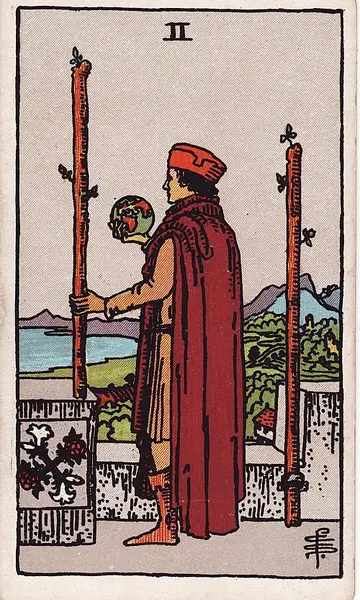
When upright, the Two of Wands reflects a moment where you are already secure, yet aware that your current territory is no longer enough. You have built a solid foundation, and the question is no longer about immediate survival, but about where you want to expand next.
The card centres on keywords like planning, decision, horizon, ambition, boldness, and discovery. In the Rider–Waite–Smith tradition, Arthur Edward Waite noted a certain restlessness beside this card’s magnificence—the feeling of an achiever who recognises that stability alone does not satisfy the urge to grow.
Its upright message is to plan from strength. Rather than rushing blindly, take the time to evaluate your options and prepare for future growth. The core advice is simple: choose your direction with clarity and sketch out a concrete plan to get there.
What does the Two of Wands mean reversed?
Reversed, the Two of Wands suggests that a plan has stalled. This pause often comes from a reluctance to leave familiar surroundings, second-guessing your abilities, or a fear of the unknown. You might find yourself lingering in your comfort zone even when you know you have outgrown it.
Waite described the reversed card with words like surprise, wonder, emotion, trouble, and fear. It can also point to poor planning, such as leaping ahead without adequate research or staying frozen in endless analysis.
When this card appears reversed in a reading, it invites you to notice where hesitation is holding you back. Shifting away from grand, overwhelming deliberations toward small, concrete steps is often the most grounded way forward.
How does the Two of Wands show up in love?
In relationships, the Two of Wands asks whether you want to keep things comfortable or venture further together. It often marks a turning point where partners discuss their long-term vision, shared goals, or the next stage of commitment.
For an individual, it reflects a personal decision about what you truly want from a partnership. You may be weighing whether your current dynamic aligns with your broader personal horizons or evaluating what kind of connection will support your ongoing growth.
How does the Two of Wands apply at work and with money?
At work, this card highlights weighing expansion. You may be considering a new venture, pitching an ambitious project, or exploring opportunities outside your current field. The card encourages you to make a thorough plan before making your move, building deliberately on what you have already achieved.
With money, expansion is genuinely possible. It is a favourable moment to study potential investments and broaden your financial reach. Reversed, it warns against either hesitating too long out of timidity or committing funds to a venture without doing the necessary research first.
Does the Two of Wands mean yes or no?
The Two of Wands reads as a maybe. Because this card represents a threshold of planning and decision-making rather than the final execution, the outcome depends on the direction you choose and the preparation you put in place.
What is pictured on the card and why?
In the Rider–Waite–Smith deck, published in 1909 with illustrations by Pamela Colman Smith, the card depicts a man standing on a castle rampart. He holds a small globe in his right hand and rests his left hand on a tall staff, while a second staff is fastened securely to the wall beside him.
From his elevated terrace, he looks past a small town toward land, hills, and the open sea. This imagery captures dominion already won alongside the quiet wish for something more. The miniature globe in his palm signifies the wider world he is actively weighing up.
On the stone wall, a carved emblem displays a cross made of red roses and white lilies. In classic symbolism, this represents the union of desire and purity, suggesting that ambition is at its healthiest when passion is tempered by clear intentions.
What do the number and suit tell us?
The suit of Wands governs career, ambition, creative drive, and action. It reflects the spark of initiative and the energy you bring to your projects.
In tarot numerology, Twos represent choice, balance, and partnership. Within the active suit of Wands, that numerical energy creates a contemplative pause: the initial spark of the Ace has been secured, and you must now balance your options and choose how to channel your drive effectively.
What are the card’s traditional correspondences?
The Two of Wands belongs to the Minor Arcana and carries established correspondences from the Hermetic Order of the Golden Dawn system:
- Suit Element: Fire, representing enthusiasm, vision, and drive.
- Astrological Decan: Mars in Aries, combining the decisive initiative of Mars with the pioneering momentum of Aries.
- Golden Dawn Title: Lord of Dominion, reflecting mastery over an established space and the confidence to look beyond it.
Which cards strengthen or change the Two of Wands?
Because the Two of Wands is rooted in the element of Fire, its interaction with other cards depends on elemental balance:
- With other Fire cards: The card’s ambitious drive intensifies. The urge to expand becomes more urgent, nudging you to move from preparation into direct action.
- With Air cards: Air feeds Fire with intellect, strategy, and communication. These pairings sharpen your planning phase, helping you articulate your ideas with mental precision.
- With Earth cards: Earth grounds the fiery vision. It provides practical structure, budgets, and realistic timelines, ensuring your ambitions have solid ground to stand on.
- With Water cards: Water brings emotional reflection. It asks you to check whether your ambitious goals truly align with your inner feelings, softening restless drive with personal meaning.
What are common mistakes when reading this card?
A frequent misunderstanding is treating the Two of Wands as a partnership card simply because of its number. In this image, the two staves do not represent two people collaborating; they symbolise one person’s alternative options and paths.
Another mistake is assuming the card describes a journey already underway. The figure remains firmly on his castle terrace. This card is about the deliberate planning that happens before the journey begins, not the travel itself.