In tarot, the Eight of Pentacles represents diligent apprenticeship, patient craftsmanship, and the conscious refinement of your skills. It reflects a mindset where mastery is earned through steady repetition, reminding you that lasting personal growth is built one deliberate piece at a time.
What does the Eight of Pentacles mean upright?
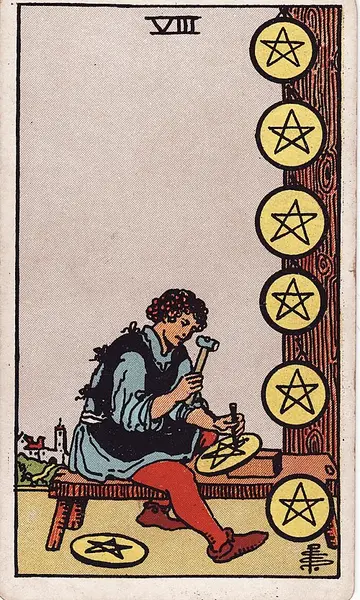
When the Eight of Pentacles appears upright, it points to dedicated apprenticeship, craftsmanship, and quiet focus. This is an invitation to immerse yourself in the details of whatever you are creating, studying, or building.
In the Rider–Waite–Smith tradition, published in 1909, Arthur Edward Waite associated this card with work, employment, commission, and practical skill in craft and commerce, often while still at a preparatory stage. The Hermetic Order of the Golden Dawn titled it the Lord of Prudence, highlighting careful, methodical effort rather than hasty ambition. The card encourages you to keep practising, knowing that confidence and competence grow through steady application.
What does the Eight of Pentacles mean reversed?
When reversed, the Eight of Pentacles suggests that your work may have lost its heart or clear direction. It often reflects perfectionism that paralyzes progress, creeping boredom with the process, or shoddy effort born of impatience.
Waite noted that the reversal can bring voided ambition, vanity, cupidity, exaction, and usury—instances where genuine skill is traded for shortcuts or turned toward cunning and sharp practice. If you find yourself here, it is a cue to pause and remember why you chose this path in the first place.
How does the Eight of Pentacles read in love?
In love readings, the Eight of Pentacles is about actively working at the relationship. A lasting bond rarely sustains itself on initial enthusiasm alone; it thrives through daily attention, considerate communication, and mutual effort.
This card suggests showing up for your partner through small, consistent actions. When you treat the relationship with the care of a thoughtful craft, you create a stable emotional foundation where both people can feel valued and understood.
What does the Eight of Pentacles mean for work and money?
In professional questions, the Eight of Pentacles highlights skill-building and steady work. It indicates a period of refining your expertise, learning a new trade, or taking pride in high standards of everyday output.
Financially, the card represents steady income earned through genuine skill and honest application. Reversed, it warns against dead-end work where you learn nothing, or the temptation to rely on questionable shortcuts instead of solid, transparent value.
Is the Eight of Pentacles a yes or no card?
In a simple inquiry, the Eight of Pentacles reads as a yes. It reflects practical progress, constructive focus, and the positive outcome that comes from applying yourself directly to the task at hand.
What is pictured on the card and why?
The visual design created by Pamela Colman Smith in 1909 shows a craftsman sitting at a wooden bench, carving pentacles one after another. Six finished pentacles hang neatly on a post beside him, one is under his chisel, and an eighth rests on the ground ready to be shaped. In the background, a small town sits in the distance.
Every element in this scene reinforces the card’s theme. The repeated pentacles represent practice and intentional repetition—the only true route to mastery. The distant town symbolizes the broader social world that the craftsman has temporarily stepped away from, choosing solitude and deep concentration over distraction.
What do its number and suit reveal?
The suit of Pentacles governs the Earth element, which centers on money, work, health, and material security. It deals with the tangible, sensory aspects of life where physical effort produces concrete results.
The number eight in tarot signifies movement, power, mastery, and work. Within the suit of Pentacles, this active energy is grounded into tangible application: the personal discipline and sustained concentration required to master a practical craft.
What are the traditional correspondences of the Eight of Pentacles?
In the Golden Dawn system of correspondences, the Eight of Pentacles holds specific astrological and elemental associations:
- Suit Element: Earth, representing stability, patience, physical reality, and pragmatic growth.
- Golden Dawn Title: Lord of Prudence, reflecting steady, careful stewardship of one’s energy and resources.
- Astrology: Sun in Virgo. The vital energy, clarity, and purpose of the Sun combine with the analytical, service-oriented, and meticulous nature of Virgo, emphasizing dedicated attention to detail.
How does the Earth element interact with other suits?
Because the Eight of Pentacles belongs to the suit of Pentacles, its Earth energy interacts with the other elemental suits in distinct ways:
- Earth with Earth (Pentacles): Reinforces patience, physical routine, and grounded dedication, though it can become overly cautious if unchecked.
- Earth with Water (Cups): Water brings emotional meaning, intuitive depth, and genuine fulfillment to the practical work of Earth, turning repetitive tasks into an act of love.
- Earth with Air (Swords): Air supplies analytical planning, strategic vision, and intellectual clarity to Earth’s hands-on labor, helping ensure that practical efforts serve a well-conceived goal.
- Earth with Fire (Wands): Fire provides inspiration, creative spark, and enthusiasm, while Earth provides the stamina and structure needed to turn those creative sparks into tangible reality.
What are the common misreadings of the Eight of Pentacles?
A frequent misconception is viewing the Eight of Pentacles as tedious drudgery or endless, unrewarding labor. In reality, the card represents intentional skill-building; the craftsman works with clear purpose and pride in their craft.
Another common mistake is assuming the card signals burnout or overwork by default. The Eight of Pentacles does not depict exhaustion; it depicts healthy, voluntary focus. The boundary between fulfilling practice and overwork lies in why and how you apply yourself.