In tarot, the Seven of Pentacles represents a moment of patient assessment. It marks a conscious pause where you step back from daily effort to examine what has grown from your labor, evaluate your long-term investments, and allow natural progress to unfold without forcing results.
What is the upright meaning of the Seven of Pentacles?
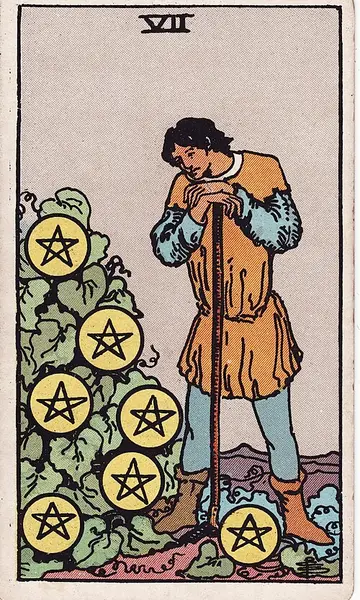
Upright, the Seven of Pentacles centers on patient assessment: investing time, waiting for growth, and reviewing your long-term effort. It is an emblem of perseverance, reminding you that meaningful results take time to mature.
In the Rider–Waite–Smith tradition, published in 1909, Arthur Edward Waite noted that this card carries diverse associations—chiefly concerning money, business, and barter, though older readings touched on quarrels or innocence. Above all, the figure’s heart is on his treasure. In the Hermetic Order of the Golden Dawn, it is titled the “Lord of Success Unfulfilled.” This title does not imply failure, but rather highlights that growth is not yet harvest. The core advice of the card is straightforward: assess your situation honestly, then keep tending what is growing.
What does the Seven of Pentacles mean when reversed?
When reversed, patience falters. The card points to impatience, poor returns, and a feeling of wasted effort. You may experience frustration when steady work does not produce quick rewards, or feel tempted to abandon an endeavor prematurely.
Waite noted that the reversal often reflects anxiety about money one is asked to lend. In personal reflection, the reversed Seven of Pentacles invites you to weigh your current commitments objectively. It prompts you to decide whether you simply need to renew your patience and continue tending, or whether it is wiser to cut your losses and redirect your resources.
How does the Seven of Pentacles apply to love and relationships?
In matters of love, the Seven of Pentacles signifies a slow-growing bond that asks for patience. Deep emotional connections take time to establish roots and flourish.
This card suggests taking a gentle pause to appreciate the foundation you have built together. It invites you to assess how both people are investing care into the relationship, allowing affection and trust to deepen naturally without rushing forward or demanding immediate milestones.
How does the card speak to work and money?
In professional contexts, the guidance is clear: review results and wait. When a project is underway, restless tinkering can disrupt natural development. Step back, evaluate what has been accomplished so far, and let the work take shape.
Financially, long-term investment needs patience. This card advises reviewing your financial position carefully before adding more resources. When reversed, it warns of poor returns or worry over a loan, suggesting extra prudence before lending funds or entering speculative commitments.
Does the Seven of Pentacles mean yes or no?
In a yes-or-no question, the Seven of Pentacles reads as a maybe.
Because the card represents an intermediate stage of evaluation and ongoing cultivation, the outcome is still developing. It suggests that the final result depends on patience and thoughtful tending rather than an immediate conclusion.
What is pictured on the card and why?
The Rider–Waite–Smith illustration shows a young farmer leaning on his hoe and looking at seven pentacles growing on a green bush.
The farmer pauses deliberately in his labor to assess the harvest. His posture conveys patience mixed with doubt, while the pentacles hanging on the bush symbolize slow returns on effort. He has invested real work into the ground, and while the growth is visible, it is not yet time to reap what he has sown.
What do the number seven and the suit of Pentacles represent?
The suit of Pentacles focuses on money, work, health, and material security. It represents the tangible, practical structures that support everyday life and well-being.
In tarot, the Sevens correspond to reflection, testing, and assessment. When combined with the suit of Pentacles, this energy brings a necessary pause in the material realm. It asks you to test whether your tangible investments of labor and resources are truly yielding the lasting security you desire.
What are the card’s astrological and esoteric correspondences?
The Seven of Pentacles belongs to the element of Earth, emphasizing grounded reality, physical patience, and steady effort.
Under the Golden Dawn system, its astrological correspondence is Saturn in Taurus, and its title is the “Lord of Success Unfulfilled.” Saturn represents discipline, structure, and the test of time, while Taurus provides the persistent, earthy endurance needed to see things through. Together, they reflect the quiet dedication required for lasting material growth.
How does the Seven of Pentacles interact with other elements?
As an Earth card, the Seven of Pentacles approaches life through practical reality and grounded patience. When reading cards alongside one another, understanding elemental dynamics provides useful perspective:
When combined with Fire, the fiery urge for rapid action contrasts with Earth’s deliberate pace, asking you to temper sudden enthusiasm with realistic timelines.
With Water, emotional care and empathy nourish Earth’s practical soil, helping you stay connected to what you value while you wait.
With Air, mental clarity and objective perspective enhance your ability to assess progress, though excessive analysis can turn patience into unnecessary worry.
With other Earth cards, the focus on physical resources and perseverance is amplified, underscoring the value of steady, quiet dedication.
What are common misreadings of the Seven of Pentacles?
A frequent misunderstanding is mistaking the Seven of Pentacles for laziness. The pause shown on the card is not avoidance; it is a necessary pause to assess what has been accomplished.
Another mistake is reading the card as failure. The harvest is simply not ripe yet; ongoing growth should not be confused with a lack of success.
Try it yourself
- Where in my life would I benefit from pausing to assess my progress rather than rushing ahead?
- Am I giving my current efforts enough time to grow, or am I letting impatience take over?
- How can I tell whether a project needs more patient tending or a change of direction?
- What expectations about immediate results can I let go of today?