The Emperor represents order, authority, and protective structure. In a tarot reading, this Major Arcana card speaks to establishing clear boundaries, practicing disciplined leadership, and turning chaos into a stable, working system. Rather than predicting events, tarot serves as a calm conversation with yourself, and The Emperor invites you to examine your relationship with personal agency, structure, and responsibility.
What does The Emperor mean upright?
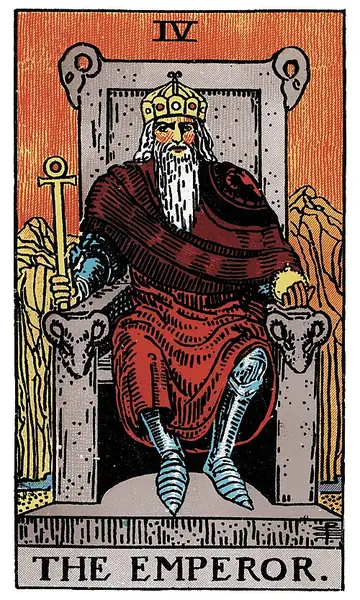
Upright, The Emperor stands for stable control, clear rules, and the authority that protects. As part of the Major Arcana, it highlights big life themes and turning points that go beyond the everyday, pointing to moments where creating order is essential. In the Rider–Waite–Smith tradition, published in 1909, Arthur Edward Waite associated this card with stability, power, protection, realisation, reason, and conviction.
The upright Emperor shows a firm hand turning confusion into a functional framework. It advises you to set clear rules and keep them, acting as the steady hand the situation needs. This card can represent an external figure—such as an employer, a mentor, or a father figure—but it just as frequently reflects your own capacity to lead, organize your life, and take full accountability for your actions.
What does The Emperor mean reversed?
When reversed, authority tends to break down in one of two distinct directions: either through rigid control and tyranny, or through a lack of discipline and a complete vacuum of leadership. In Waite’s notes, the reversal touches upon obstruction and immaturity on one hand, and misplaced benevolence or compassion without practical backing on the other.
A reversed Emperor prompts you to reflect on where structure has become an oppressive cage that stifles flexibility. Alternatively, it can expose areas where boundaries have collapsed, leading to disorganization and missed commitments. It encourages you to ask where your grip has become too tight, or where you need to step up and restore structure.
How does The Emperor apply to love and relationships?
In love, The Emperor signifies a dynamic that is stable and protective. It points to a relationship built on clear expectations, dependability, and mutual security, where both partners feel grounded and looked after.
However, this card also carries a gentle warning about the balance of control. Structure supports intimacy only when it remains fair and open; if protection hardens into micromanagement or emotional rigidity, it can become controlling. It offers an opportunity to check whether your relationship’s ground rules are keeping you secure or merely keeping you guarded.
How does The Emperor relate to work and money?
In professional environments, The Emperor is right at home. It signifies leadership, clear operating rules, and a sound organizational system. It encourages approaching projects with strategic planning, clear hierarchies, and reliable processes rather than improvisation.
Regarding money, The Emperor indicates that disciplined budgeting and long-term financial plans pay off. Establishing steady financial routines and avoiding impulse spending creates durable security. Reversed, it warns against either overly rigid financial constraints or a messy, disorganized structure that makes it difficult to manage resources.
Does The Emperor mean yes or no?
When you are looking for a simple directional answer, The Emperor reads as a yes. It indicates that the situation has the necessary structure, stability, and focus to succeed, especially if you apply discipline and clear planning to see it through.
What is pictured on The Emperor card and why?
In the classic 1909 Rider–Waite–Smith deck, drawn by Pamela Colman Smith, a crowned ruler in full armour sits on a heavy stone throne carved with rams’ heads. He holds an ankh sceptre in one hand and an orb in the other, framed against a backdrop of bare, craggy mountains.
Every visual element illustrates authority that builds order. The rams’ heads symbolize the astrological sign of Aries, representing initiating drive and assertive determination. The armour beneath his imperial robes indicates a constant readiness to defend and protect what has been established. The barren peaks behind the throne represent the unyielding, hard ground that human organization and discipline must conquer and shape into a functioning world.
What are the traditional correspondences of The Emperor?
In the Hermetic Order of the Golden Dawn, The Emperor was assigned specific attributions that map its place in the Western esoteric tradition:
- Golden Dawn Title: Sun of the Morning, Chief among the Mighty
- Astrology: Aries
- Hebrew Letter: Heh (window)
- Kabbalistic Path: Path 15: Chokmah-Tiphareth
- Element: Fire
The Golden Dawn assigned the astrological sign Aries to The Emperor. The elemental classification of Fire is a modern convention derived directly from the Golden Dawn system, which matches a sign card to the element of that sign. Practitioners use this elemental correspondence when evaluating elemental dignities between cards in a spread.
Which cards strengthen or change The Emperor?
When The Emperor appears alongside The Empress, the two cards represent nurture and authority in balance. The Empress brings fertile creativity, organic growth, and warmth, while The Emperor provides the structure, protection, and systems necessary to shelter that growth. Together, they describe a stable household, a mature creative partnership, or a project that combines vision with disciplined execution.
What are common mistakes when interpreting The Emperor?
A frequent mistake is assuming that an upright Emperor must represent a tyrant or an abusive partner. Upright, this card stands for healthy structure, fairness, and protective boundaries, not cruel domination.
Another common error is reading The Emperor strictly as an external man or an actual father. Tarot archetypes are not bound to specific genders or outside people. Anyone can embody this energy, and the card very often points to your own ability to step forward and lead.