At its core, the Five of Cups reflects grief, disappointment, and regret over what has spilled, while quietly reminding you that two cups still stand upright behind you. It serves as a gentle prompt to acknowledge emotional sorrow honestly, without overlooking the hope and support that remain intact.
What does the Five of Cups mean upright?
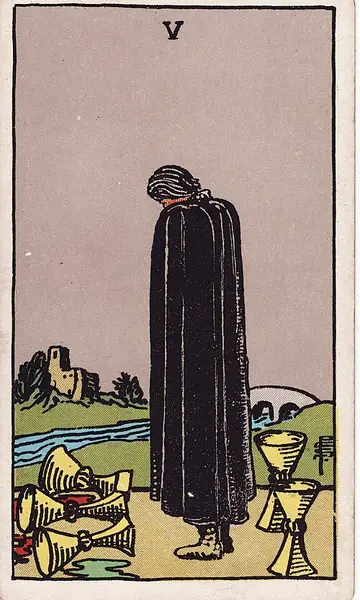
In an upright reading, the Five of Cups points to mourning, regret, and the human tendency to fixate on what has been lost. It often appears when you are processing a painful disappointment or an outcome that did not match your hopes.
In the Rider–Waite–Smith tradition, published in 1909, Arthur Edward Waite described this as a card of loss where something remains: three cups are taken, but two are left standing. He also associated it with practical letdowns, such as an inheritance falling short of expectations. The advice of the card is simple and compassionate: grieve honestly, feel the weight of the moment, and then turn around to see what is still standing.
What does the Five of Cups mean reversed?
When reversed, the Five of Cups signals that recovery is underway. The sharpest edge of grief begins to soften into acceptance, forgiveness, and a renewed openness toward life. Rather than staring down at the spilled liquid, you begin to turn around.
Waite linked the reversal to news, alliances, kinship, return, and false projects fading into perspective. The emotional fog clears enough to show that the bridge across the river can finally be crossed. It is a quiet return to connection and self-compassion.
What does the Five of Cups show about love?
In matters of love and relationships, the Five of Cups touches upon heartbreak, sorrow, and lingering regrets. It marks a period of sadness over an emotional rupture or a connection that did not unfold as hoped.
Even in deep heartache, the card emphasizes that not all is lost. Something meaningful remains—whether that is your own capacity to care, lessons in personal boundaries, or the love of friends. The card invites you to honor the sadness without concluding that your emotional life is entirely empty.
How does the Five of Cups apply to work and money?
In your professional life, this card points to a setback, a missed milestone, or a project that did not yield the results you envisioned. Instead of abandoning the entire venture out of frustration, the focus should shift to what was saved and what can still be used.
Financially, the Five of Cups reflects a loss or disappointment, such as an investment performing below expectations or unexpected expenses. However, it is not a sign of total financial ruin. When reversed, it often suggests recovering part of what was lost or discovering practical stability through remaining resources.
Does the Five of Cups mean yes or no?
In a simple inquiry, the Five of Cups reads as a no.
It highlights a time of processing disappointment, reflection, and sorting through difficult emotions. Rushing forward into a new venture right now could lead to overlooked details, so the card suggests pausing until clarity returns.
What is pictured on the card and why?
Illustrated by Pamela Colman Smith under Waite’s direction, the card depicts a figure draped in a heavy black cloak, head bowed low in mourning over three overturned cups. Their red and green contents spill onto the barren ground. Directly behind the figure, two full cups stand upright and undisturbed. In the distance, a small bridge crosses a river, leading to a fortified house or castle.
The imagery captures how intense grief can narrow our perception. The bowed mourner is consumed by what was ruined, entirely blind to the two upright cups behind them. The upright cups represent what is not lost, while the bridge symbolizes the way back home once the mourner decides to turn around.
What do the number and suit reveal?
The suit of Cups is rooted in the element of Water, which governs our inner landscape: emotions, love, and relationships. It speaks the quiet language of intuition, emotional vulnerability, and bonding.
In tarot numerology, Fives disrupt the peace and structure established by the Fours. They bring themes of conflict, loss, instability, and change. When the unstable energy of a Five enters the emotional world of Cups, it manifests as sorrow, emotional turbulence, and the necessary shifts that follow personal disappointment.
What are the traditional correspondences?
In the Hermetic Order of the Golden Dawn tradition, the Five of Cups is designated as the Lord of Loss in Pleasure. Its astrological attribution is Mars in Scorpio, placing the assertive, direct drive of Mars within the deep, fixed waters of Scorpio. This correspondence reflects the intense emotional sting of disillusionment, alongside the quiet, underlying resilience required to endure and rebuild.
Which cards strengthen or change the Five of Cups?
When read alongside other cards, the Five of Cups takes on specific nuances:
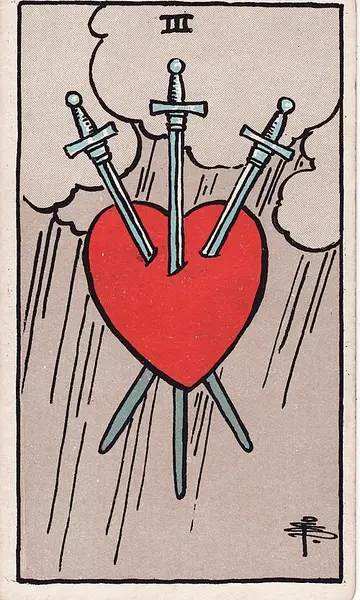
- Five of Cups + Three of Swords: This pairing highlights deep heartbreak and grief, underscoring personal sorrow while maintaining the quiet truth that something of value still remains to be salvaged.
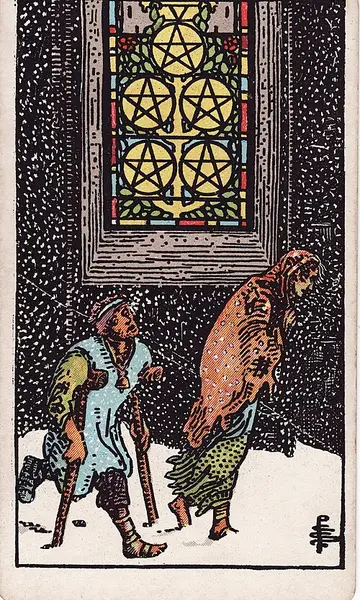
- Five of Cups + Five of Pentacles: This combination mirrors emotional loss intertwined with practical or material hardship. Even in the cold, it carries the reminder that assistance and shelter are nearby if you lift your gaze to look for them.
What are common misreadings of this card?
A frequent misconception is reading the Five of Cups as a symbol of complete and total devastation. It never depicts total loss; two full cups always remain standing behind the figure, symbolizing hope and surviving value.
Another mistake is assuming the card only applies to romantic breakups. The Five of Cups speaks to any form of sorrow, missed opportunity, creative setback, or quiet regret in everyday life.
Try it yourself
When the Five of Cups appears in your spread, here are a few gentle questions you can bring into a conversation with the bot:
- What disappointment am I currently holding onto, and how can I honor that feeling?
- What relationships, strengths, or resources remain intact behind me right now?
- What small step can I take today to begin crossing the bridge toward recovery?
- How can I gently shift my attention from what spilled to what can still be nurtured?