In a tarot reading, the Four of Pentacles represents holding on tight: security built through control, possessiveness, and careful saving. It marks a moment where you are safeguarding what you have built or acquired, creating stability while navigating the quiet line between sensible prudence and rigid self-protection.
What does the upright Four of Pentacles mean?
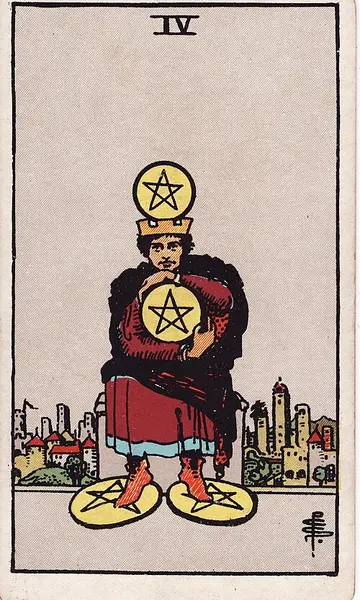
Upright, the Four of Pentacles centres on security, saving, control, stability, and conservatism. It shows a posture of holding firmly to what is yours. In the Rider–Waite–Smith tradition, published in 1909, Arthur Edward Waite described this figure as holding to what he has: the surety of possessions, whether that comes in the form of earned assets, a gift, a legacy, or an inheritance.
On a practical level, this card favours prudent saving and clear boundaries. It acknowledges the comfort of knowing your foundation is secure. At the same time, it serves as a gentle check on your posture: a tightly closed hand protects what it holds, but it cannot receive anything new, and a guarded stance can easily lead to a closed heart. The core guidance here is balanced: keep what you need, and loosen your grip on the rest.
What does the reversed Four of Pentacles mean?
When reversed, the grip changes. The card can point to a conscious letting go, an opening up toward generosity, and releasing the anxious fear of lack. When you stop clutching so tightly to control, resources and energy begin to circulate again.
However, the reversal can also swing to the opposite extreme: loss through greed, careless overspending, or a sudden loss of hold. Waite associated the reversed card with suspense, delay, and opposition. In your own reflections, the reversed Four of Pentacles invites an honest check-in: ask whether what you protect still serves you, or whether your hold on safety has begun to restrict your movement.
What does the Four of Pentacles mean in love and relationships?
In relationship readings, the Four of Pentacles reflects a possessive or guarded attitude. It often highlights a fear of vulnerability, where you or a partner might be keeping your guard up, withholding feelings to avoid being hurt or caught off-guard.
While personal boundaries are healthy, holding on too tightly can stifle the natural breathing room a partnership needs. Possessiveness, jealousy, or emotional defensiveness can creep in when security is sought through control. The card invites you to reflect on where caution has turned into emotional rigidity, encouraging you to nurture safety through openness rather than confinement.
What does the Four of Pentacles mean for work and money?
In matters of work and money, this card represents careful saving and holding onto assets. It indicates a period of financial stability, but one that may come with rigidity. You might be managing your budget strictly, focusing on job security, or protecting your current position.
While this protects your resources, it can also lead to stagnation at work. By avoiding calculated risks or refusing to delegate, you may miss out on professional growth. When reversed, the card points either to a healthy loosening of control—such as investing or spending on what matters—or to the danger of financial mismanagement and overspending.
Is the Four of Pentacles a yes or no card?
In a yes-or-no question, the Four of Pentacles reads as a maybe.
Because the card embodies hesitation, preservation, and maintaining the status quo, it suggests that the situation is currently on hold. It asks you to look at where you are clinging to certainty before expecting a clear movement forward.
What is pictured on the card and why?
In the Rider–Waite–Smith illustration, a crowned man sits clutching one pentacle tightly to his chest with both arms. Another pentacle is balanced atop his crown, and two more are planted firmly beneath his feet. In the background, a busy city skyline rises behind him.
Every detail illustrates security held tight. His physical grip is an expression of control and the quiet fear of loss. The pentacle on his head blocks higher insight, the one on his chest guards his heart, and the two underfoot lock him in place. Meanwhile, the city behind him represents the active world of human exchange and movement that he has shut out to preserve his hoard.
What do its number and suit represent?
The suit of Pentacles belongs to the element of Earth, governing money, work, health, and material security. It deals with the tangible, practical structures of daily life.
Within this suit, the Fours represent stability, structure, or stagnation. While a Three represents early growth and collaboration, a Four consolidates that progress into a firm framework. In the suit of Pentacles, this consolidation brings solid grounding, but also the risk of becoming trapped in the very structure you built for safety.
What are its traditional correspondences?
In the esoteric system of the Hermetic Order of the Golden Dawn, the Four of Pentacles carries the title Lord of Earthly Power.
Its astrological correspondence is the Sun in Capricorn. This decan attribution unites the radiant vitality and focused identity of the Sun with the disciplined, pragmatic, and cautious nature of Capricorn. Together, they reflect the desire to establish lasting material authority and maintain order over physical resources.
How does the element of Earth combine with other suits?
As an Earth card, the Four of Pentacles responds directly to the elements around it in a reading:
When paired with Water (Cups), the emotional depth and fluidity of Water soften Earth’s rigidity. Compassion and emotional connection help loosen a tight material or defensive grip.
When meeting Air (Swords), Earth’s practicality combines with intellect and logic. This can provide structured, strategic planning, but it may also turn cautious holding into chronic worry or overthinking about loss.
When combined with Fire (Wands), the dynamic drive of Fire challenges the conservative nature of Earth. Fire’s passion can shake off stagnation, though it may initially trigger an urge to reassert control.
Alongside other Earth cards (Pentacles), the focus on security, tangible assets, and patience is reinforced, creating exceptional stability that must be watched to avoid complete immobility.
What are common mistakes when reading this card?
A common mistake is assuming that the Four of Pentacles represents wealth itself. It does not speak to the size of your fortune; it reflects your attitude of holding on. Someone with very little can hold just as tightly out of fear as someone with great wealth.
Another misreading is viewing the card purely as a portrait of greed or selfishness. Often, it represents legitimate prudence, necessary budgeting, and the human need for stability after going through uncertain times.