At its core, the Three of Pentacles represents skilled collaboration, craftsmanship, and recognised quality. It is an image of constructive effort where distinct talents unite to bring a tangible project to life.
What does the Three of Pentacles mean upright?
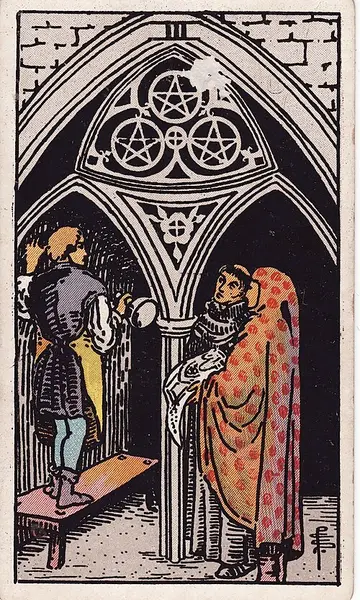
When upright, the Three of Pentacles reflects craftsmanship, teamwork, and quality that is openly recognised. It shows that your skills are finding their proper place within a wider effort, and that your competence is noticed and respected.
In the Rider–Waite–Smith tradition (deck published 1909), Arthur Edward Waite associated this card with trade and skilled labour, interpreting it above all as nobility, renown, and glory. The card favours situations where an apprenticeship pays off, standards are upheld, and individuals coordinate their abilities toward a common goal. Its core advice is simple: bring your skill into a team with a clear shared plan.
What does the Three of Pentacles mean reversed?
Reversed, the card signals that the work is suffering. This often points to poor teamwork, shoddy execution, or an absence of genuine collaboration. It can indicate a setting where skills go unacknowledged, or where basic standards are neglected.
Waite noted that the reversal reflects mediocrity in work and elsewhere, alongside puerility, pettiness, and weakness. When this card appears reversed in a reading, it invites you to pause and check the blueprint: are all contributors truly aligned, or are personal egos and lack of commitment getting in the way of quality?
How does the Three of Pentacles apply to love and relationships?
In relationship readings, the Three of Pentacles represents building something together. It steps away from passive romantic ideals and focuses on the practical foundations of partnership.
This card appears when two people actively work to structure their shared life, resolve practical questions, or cooperate smoothly on domestic and long-term plans. It highlights mutual respect for what each partner brings to the table and shows that steady, collaborative effort strengthens emotional bonds.
What does the Three of Pentacles show for work and money?
In professional readings, the Three of Pentacles indicates a team project where your craft is recognised. It is an encouraging sign for specialists, contractors, and colleagues who need to pool their expertise. Your technical competence and dedication to detail stand out to those around you.
Financially, the card points to income derived from craft, teamwork, and signed contracts. It reflects earnings rooted in tangible competence and fair agreements. Reversed, however, it warns of poor-quality deliverables, miscommunications in contracts, or a team that fails to deliver on its promises.
Does the Three of Pentacles read as a yes or a no?
The Three of Pentacles reads as a yes. It offers constructive encouragement, particularly for questions concerning joint ventures, career development, learning a trade, and projects built on careful planning.
What is pictured on the card and why?
In the classic Rider–Waite–Smith deck (1909), illustrated by Pamela Colman Smith, a sculptor stands on a wooden bench inside a stone cathedral arch, chisel and mallet in hand. Beside him, a monk and a hooded figure holding architectural plans consult with him, reviewing the ongoing work.
This imagery illustrates skill recognised within a shared project. None of the figures can complete the cathedral alone: the architect supplies the blueprint, the monk provides the spiritual purpose, and the sculptor provides the technical execution. The three pentacles carved into the arch overhead visually join craft, planning, and spirit into a single, cohesive structure.
What do the number and suit reveal about this card?
The suit of Pentacles governs the material realm: money, work, health, and physical security. It deals with what can be touched, built, and sustained over time.
Within this suit, the rank of the Threes represents growth, collaboration, and first results. While the Ace is the initial seed and the Two balances resources, the Three marks the stage where an idea takes physical form through cooperation. It is the moment where individual effort integrates into the social and professional world to yield visible progress.
What are the astrological and esoteric correspondences?
In the Golden Dawn correspondences, the Three of Pentacles carries the title “Lord of Material Works.” It is attributed to the suit element of Earth and the astrological decan of Mars in Capricorn.
This astrological pairing reflects disciplined, structured ambition. Mars brings energy, focus, and drive, while Capricorn provides patience, hierarchy, and respect for practical craftsmanship. Together, they channel raw effort into lasting, high-quality work.
How does its Earth element combine with other suits?
As an Earth card, the Three of Pentacles expresses grounded realism and steady construction. Observing how it interacts with other elements helps illuminate the flow of your reading:
- Earth with Earth: Strengthens stability, meticulous attention to detail, and a focus on practical execution, though progress may feel deliberate and slow.
- Earth with Water: Blends practical collaboration with emotional trust, helping creative or interpersonal ventures grow in a supportive environment.
- Earth with Air: Connects blueprints and strategic analysis with practical building, ensuring that discussions turn into concrete results.
- Earth with Fire: Provides the structure necessary to ground creative passion, turning initial enthusiasm into organised, productive output.
What are common misreadings of this card?
Because the card depicts three figures, readers sometimes mistakenly interpret it as a love triangle. The Three of Pentacles is not about romantic interference; it depicts professional consultation and collaboration on a shared project.
Another frequent mistake is assuming the card represents finished mastery. The scene takes place within an unfinished building with tools in hand: it represents good work in progress that is recognised, rather than the final, completed monument.
Try it yourself
- What specific skill or perspective do I bring to my current collaborative project?
- Where would consulting with others or clarifying the plan improve the quality of my work?
- How can my partner and I better coordinate our daily efforts to build our shared life?
- Am I giving and receiving fair recognition for the practical effort being contributed?