The King of Swords represents intellectual authority, truth, fair judgment, and clear reasoning. When this card appears in a reading, it invites you to step back and examine your circumstances with an objective, analytical eye, making decisions grounded in principled clarity rather than emotional turbulence.
What is the upright meaning of the King of Swords?
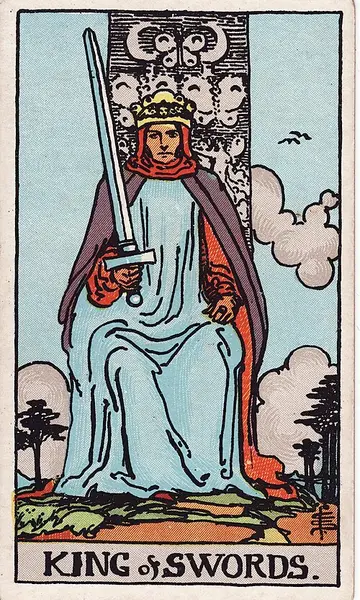
In its upright position, the King of Swords embodies mastery over the realm of the mind. He leads through logic, fairness, and structured analysis. Rather than directing situations through impulse, his authority stems from an unwavering commitment to truth and impartial standards.
In the Rider–Waite–Smith tradition (first published in 1909), Arthur Edward Waite described this king as one who sits in judgment, possessing command, law, and a militant intelligence. When facing complex dilemmas, the card favours seeking expert advice, reviewing contracts and agreements carefully, and making principled decisions. Its core advice is simple: weigh the facts honestly and choose the path dictated by clear reasoning.
What does the King of Swords reversed mean?
When reversed, clear reasoning can deteriorate into cold tyranny, manipulation, and harsh judgment. Logic, instead of clarifying truth, can be weaponised to dominate others or defend an unyielding stance.
Waite noted this reversal in stark terms, citing cruelty, perversity, barbarity, perfidy, and evil intent. In practical readings, a reversed King of Swords often points to an abuse of authority, rigid dogmatism, or cold calculation devoid of empathy. When this card appears upside down, it serves as a prompt to pause and reflect: whose interests does this logic truly serve?
What does the King of Swords mean in love?
In relationships, the King of Swords points to an approach that prioritises rational communication and fairness over feeling. It often describes a partner who values honesty, transparency, and intellectual connection above emotional displays.
While this outlook creates clear boundaries and prevents misunderstandings, it can sometimes feel distant if feelings are dismissed entirely. In love readings, this card encourages you to keep dialogue calm, discuss expectations openly, and treat your relationships with mutual respect and integrity.
What does the King of Swords mean at work and with money?
Professionally, the King of Swords represents an expert, a lawyer, or an analytical boss. He reflects environments that reward competence, articulate communication, and strict ethical standards. When navigating career challenges, this card suggests adopting an impartial perspective and relying on facts, technical knowledge, and strategic planning.
Regarding money, the card emphasises financial clarity, legal contracts, and professional counsel. It is a sign to read agreements thoroughly, audit accounts accurately, and make financial choices based on verified data. Reversed, it warns against contract disputes, unfair terms, or the cold manipulation of resources.
Does the King of Swords mean yes or no?
The King of Swords reads as a yes. It is particularly encouraging when your question hinges on honest appraisal, structured planning, and principled actions rather than emotional impulse.
What is pictured on the card and why?
In Pamela Colman Smith’s 1909 artwork, a king sits firmly on a stone throne decorated with carved butterflies and crescent moons. He holds an upright sword tilted slightly to one side, facing straight ahead. In the background, wind stirs the trees beneath drifting clouds.
Every visual element underscores his intellectual authority. His direct, forward gaze represents impartiality and balanced judgment. The upright sword conveys the power of law, clear discrimination, and decisive action. The butterflies carved into the throne evoke the lightness and transformative nature of the mind, while the wind and clouds reflect his domain within the suit of Air.
What does this court card say as a person and as an attitude?
In tarot convention, court cards can represent an external person or an attitude and role within yourself. The rank of Kings corresponds to outer mastery, authority, and decisions.
As a person, the King of Swords can signify someone in your life who is analytical, communicative, and objective—someone who offers candid, unbiased guidance. As an attitude, the card calls you to step into your own intellectual command. It asks you to rise above emotional reactivity, look at the evidence objectively, and lead your life through fair and deliberate choices.
What are the traditional correspondences of the King of Swords?
The King of Swords belongs to the suit of Swords, which governs thoughts, communication, conflict, and decisions.
- Suit Element: Air
- Astrology: Fire of Air, Gemini
- Golden Dawn Title: Lord of the Winds and the Breezes; King of the Spirits of Air
These attributions, drawn from the Hermetic Order of the Golden Dawn, unite the communicative and analytical nature of Gemini with the decisive authority of the King rank.
How does the King of Swords combine with other elements?
Because the suit of Swords represents the element of Air, its dynamic shifts depending on how it interacts with other elemental suits:
- Air and Fire (Wands): Fire brings enthusiasm and drive, while Air supplies strategy and intellectual direction, resulting in focused, purposeful action.
- Air and Water (Cups): Water brings emotion and empathy, while Air provides objectivity, helping balance compassionate feelings with clear judgment.
- Air and Earth (Pentacles): Earth provides practical grounding and material focus, while Air offers systemic analysis, turning plans into durable contracts and realistic structures.
- Air with Air (Swords): Two Air cards amplify analytical precision and open communication, though they also remind you not to get lost in excessive overthinking.
What are common mistakes when reading the King of Swords?
A frequent misreading is assuming that the King of Swords is cold or heartless. He is not unfeeling; rather, he prioritises fairness, rationality, and principled judgment so that decisions remain just and uncompromised.
Another mistake is assuming this card must literally represent a lawyer or legal official. While he certainly aligns with legal matters, he represents anyone who exercises intellectual authority, rigorous problem-solving, or professional expertise.
Try it yourself
- How can I bring more fairness and clear reasoning to my current situation?
- Where would I benefit from seeking expert advice or objective facts right now?
- What boundaries or principles do I need to uphold in my next important conversation?
- Am I viewing this matter with impartial clarity, or am I letting my emotions cloud my judgment?