The Queen of Swords represents clear-eyed perception, personal independence, and open honesty. In tarot, this card invites you into a calm conversation with yourself about seeing through illusions, setting healthy boundaries, and speaking your truth with clarity earned through experience.
What does the Queen of Swords mean upright?
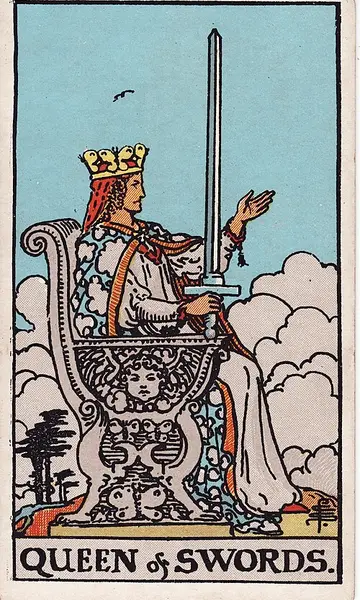
Upright, the Queen of Swords embodies perceptive judgment and quiet autonomy. She has the rare ability to strip away emotional confusion and look at circumstances exactly as they are. In the Rider–Waite–Smith tradition, published in 1909, Arthur Edward Waite described her as a figure intimately familiar with sorrow, linking her to themes of mourning, absence, and separation. Modern tarot interpretation views this background not as a sentence of eternal grief, but as lived experience that has matured into practical wisdom.
When this card shows up in a reading, it suggests you approach your situation with an independent mind and clear boundaries. She tells the truth kindly, without unnecessary harshness, but also without sugarcoating reality.
What does the Queen of Swords mean reversed?
When reversed, the natural clarity of the Queen of Swords can turn cold and sharp. The healthy detachment that once protected personal space may curdle into bitterness, cynicism, or cutting words. It points to a tendency to pass judgment without compassion, using intellect as a weapon rather than an analytical tool.
Waite’s historical notes associated the reversed card with malice, bigotry, artifice, prudery, and deceit. In a grounded self-reflective spread, the reversed Queen simply asks you to examine how you communicate hard realities. Truth delivered without warmth or empathy often causes unnecessary injury. The guidance here is to tell the truth with care.
How does the Queen of Swords appear in love?
In relationship readings, the Queen of Swords signifies an honest, independent partner who holds firm boundaries. This card speaks to connections where both people value intellectual equality, straightforward communication, and mutual respect.
It discourages mind games, passive-aggressive remarks, or unspoken assumptions. If this card reflects your own stance, it encourages you to express your needs clearly and maintain your sense of self, while remaining receptive and fair to your partner.
What does the Queen of Swords mean at work and with money?
In professional environments, the Queen of Swords represents a sharp analytic expert. She thrives in roles that require objective evaluation, critical thinking, straightforward communication, and conflict resolution. She cuts through office politics to address core challenges directly.
Regarding money, this card represents clear-headed financial management and sharp negotiation. You are encouraged to assess contracts and budgets with realistic, unsentimental precision. Reversed, it warns against cold calculation or allowing old financial disputes to breed lasting bitterness.
Does the Queen of Swords mean yes or no?
In questions seeking a simple direction, the Queen of Swords reads as a maybe.
Rather than offering an immediate green or red light, this card asks you to pause and gather the facts. It indicates that the path forward hinges on objective analysis, logical thinking, and making your own independent choice free from wishful thinking.
What is pictured on the card and why?
Illustrated by Pamela Colman Smith, the Queen of Swords sits upon a carved stone throne decorated with butterflies. In her right hand, she holds a heavy broadsword raised perfectly upright, while her left hand is extended forward in a calm, welcoming gesture. Low clouds gather along the horizon below her, while a solitary bird glides high in the open sky.
Every element carries specific meaning. The upright sword and gathering clouds reflect clear judgment shaped and tempered by sorrow. The carved butterflies signify the transformation of the soul through trials, while the solitary bird high above represents clear, undisturbed thought rising above mundane distractions.
What does this court card say as a person and as an attitude?
Tarot court cards serve a dual function: they can describe an actual person in your life—characterized by their temperament and suit—or an attitude and role within yourself. Following the traditional court convention, Queens represent inner mastery, nurturing, and intuition within their suit’s domain.
As a person, the Queen of Swords is an articulate, self-reliant realist with high standards and an honest demeanor. As an attitude, she calls you to cultivate intellectual composure. She asks you to nurture your own clarity, assess your circumstances without denial, and handle your situation with dignity and independence.
What are the card’s traditional correspondences?
The suit of Swords belongs to the element of Air, which oversees thoughts, communication, conflict, and decisions.
In the esoteric system established by the Hermetic Order of the Golden Dawn, this card bears the title Queen of the Thrones of Air. Its astrological attribution is given as Water of Air, Libra. This pairing reflects the intuitive, receptive depth of Water flowing through the communicative, balanced, and rational nature of Air and the sign of the Scales.
How does the Queen of Swords combine with other suits?
While this card does not have fixed traditional pairs, its elemental nature interacts clearly with the rest of the deck:
- With other Swords (Air): The focus on intellect and communication doubles. Situations call for absolute honesty, research, and careful debate.
- With Cups (Water): The cool logic of the Queen balances emotional waves, helping to process feelings with calm perspective rather than overwhelm.
- With Wands (Fire): Her analytical clarity can temper fiery impulses, shaping sudden passion into well-strategized, deliberate action.
- With Pentacles (Earth): Clear analysis meets tangible reality, resulting in sound contracts, pragmatic plans, and disciplined project execution.
What are common mistakes when reading the Queen of Swords?
A frequent mistake is assuming the Queen of Swords is cold, cruel, or heartless by default. She is not bitter; she simply values truth and refuses to pretend things are fine when they are not.
Another misunderstanding stems from taking historical keywords like “widow” or “divorcee” literally. Her sorrow does not mean perpetual loss; it represents experience that has been distilled into self-sufficiency and genuine wisdom.