In tarot, the Seven of Cups represents daydreaming, dazzling options, and emotional fantasy that calls for a gentle reality check. When this card appears, your imagination is running at full capacity, presenting possibilities where the line between genuine potential and wishful thinking can easily blur.
What does the Seven of Cups mean upright?
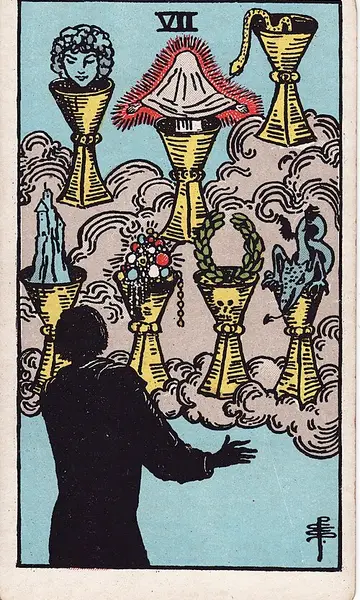
The upright Seven of Cups points to many dreamy choices, wishful thinking, and temptation. Your mind may generate endless scenarios, projects, or romantic possibilities, but few are anchored to solid ground. In the Rider–Waite–Smith tradition (deck published 1909), Arthur Edward Waite described this card as one of fairy favours, reflections, sentiment, and imagination, noting that nothing here is permanent or substantial.
This card is a calm reminder not to confuse dreams with actionable plans. Daydreams show what your heart desires, yet trying to chase every floating vision scatters your energy. The core advice of the card is simple: choose one dream and test it against reality.
What does the Seven of Cups mean reversed?
When reversed, the foggy cloud of reverie begins to clear. The reversed Seven of Cups signifies clarity, choosing at last, or watching illusions collapse. While seeing a fantasy dissolve can feel abrupt, it clears away mental clutter so you can move forward with honest expectations.
Waite associated the reversed card with desire, will, determination, and engaging with a real project. Instead of hovering in indecision among dozens of mirages, you find the focus needed to commit. You pick one cup and make it real through deliberate, practical action.
How does the Seven of Cups apply to love and relationships?
In matters of the heart, the Seven of Cups reflects idealising a partner or getting lost in romantic fantasies. You might find yourself projecting qualities onto someone that they do not actually possess, falling in love with their potential rather than who they are today.
It can also indicate having too many options, where an abundance of theoretical choices leaves you emotionally scattered. When every prospective connection seems intriguing from a distance, committing feels daunting. The card invites you to look past the surface sparkle and ask what truly nourishes an authentic bond in everyday life.
How does the Seven of Cups read for work and money?
In professional readings, the Seven of Cups speaks of scattered options. You might have numerous creative ideas, business ventures, or career paths competing for attention. The card advises you to pause and choose one instead of juggling multiple unformed concepts.
Regarding money, this card highlights unrealistic schemes and financial wishful thinking. Avoid get-rich-quick promises or speculative ventures driven by excitement. When reversed, it signals clarity about which practical choices actually safeguard your resources, helping you tell sound plans from empty daydreams.
Does the Seven of Cups mean yes or no?
In a straightforward inquiry, the Seven of Cups reads as a maybe. Because the situation is clouded by daydreams, shifting priorities, and unexamined illusions, circumstances have not yet solidified enough to point toward an outcome. The card invites you to clarify your true intentions before seeking a simple answer.
What is pictured on the card and why?
The Rider–Waite–Smith illustration shows a dark figure in silhouette, facing seven cups floating in clouds. Each vessel holds a distinct vision: a castle, jewels, a laurel wreath of victory, a dragon, a snake, a human head, and a veiled glowing figure.
These floating items represent tempting fantasies and choices. The mix of treasures and terrors shows that imagination conjures both our greatest hopes and our sharpest anxieties, yet none of them is real yet. Because they rest entirely in the clouds, they remain purely hypothetical until chosen and tested on solid ground.
What do the number seven and the suit of Cups represent?
The suit of Cups relates to the area of emotions, love, and relationships, reflecting the movements of the heart, intuition, and inner feeling.
The number seven represents reflection, testing, and assessment. Following the harmony of the Six, the Sevens introduce a necessary pause to test our assumptions. In the suit of Cups, this testing stage asks you to evaluate your emotional ideals against practical truth, separating genuine longings from passing daydreams.
What are the card’s esoteric correspondences?
Under the Golden Dawn system, the Seven of Cups receives the title “Lord of Illusionary Success.” This title captures the feeling of achieving a goal purely in the mind before taking any physical steps.
Its suit element is Water, governing intuition, feeling, and fluid perception. Astrologically, the Golden Dawn pairs the card with Venus in Scorpio. This brings together the planet of desire and value with the sign of emotional intensity and deep fixation, reflecting an intense longing that can easily become consumed by its own visions.
How does the Seven of Cups interact with other elements?
Because the Seven of Cups belongs to the element of Water, its interaction with the other elements shows how fantasies can be brought into balance:
- Water with Earth (Pentacles): Earth provides the grounding and structure that Water lacks, helping pull floating daydreams down into tangible reality.
- Water with Air (Swords): Air introduces analytical clarity, cutting through emotional mist and sorting wishful thinking from viable ideas.
- Water with Fire (Wands): Fire adds heat and passion; while it can ignite action, it can also create steam, amplifying emotional restlessness without physical progress.
- Water with Water (Cups): Deepens intuition and imagination, but risks further immersion in fantasy if left unanchored.
What are common mistakes when reading the Seven of Cups?
A frequent mistake is reading the Seven of Cups as a set of seven good options. Most of the cups are illusions or distractions rather than viable paths.
Another common error is viewing these floating cups as external promises presented to you. This card is not an outside offer; it is your own imagination at work. The visions you see in the clouds originate from within, calling for your own honest discernment.
Try it yourself
- Which of my current goals is an actionable plan, and which is still just a daydream?
- Where am I idealising a situation or a person instead of seeing the reality?
- If I set aside distractions, which single choice deserves my full focus today?
- What practical step can I take right now to test my vision against reality?