At its heart, the Two of Swords represents a stalemate: an uneasy truce where you hold back emotion and put off an uncomfortable decision. It captures a moment of paused action, balancing two opposing thoughts or options while keeping your guard firmly in place.
What does the Two of Swords mean upright?
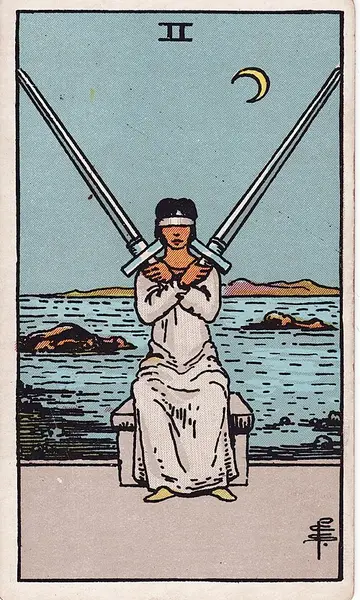
When the Two of Swords appears upright, it points to an unresolved conflict held in suspended animation. You may find yourself stuck in an avoided decision, keeping your feelings guarded behind a wall of logic. It is a state of equilibrium, but not an entirely comfortable one.
In the Rider–Waite–Smith tradition (first published in 1909), Arthur Edward Waite described this card through qualities like equipoise, conformity, courage, and friendship, but noted it reflects harmony kept under arms. Because the suit of Swords deals with intellect and friction, this balance is rarely completely easy. The peace here is real, but it remains an armed peace: a ceasefire rather than a true resolution.
What does the Two of Swords mean reversed?
Reversed, the delicate balance can no longer hold. The card indicates that a decision is being forced, the truth is emerging, or information overload is causing mental paralysis. The quiet avoidance of the upright position gives way to disruption.
Waite associated the reversal with imposture, duplicity, falsehood, and disloyalty—often reflecting what happens when pretense crumbles. When this card appears reversed in a personal reflection, the advice is clear: take off the blindfold, look at both options honestly, and choose.
How does the Two of Swords apply to love and relationships?
In love, the Two of Swords reflects refusing to face a decision. You or someone close to you may be avoiding an honest conversation to prevent friction, choosing an uncomfortable stillness over necessary clarity.
It speaks to blocked emotion and emotional self-defense. Rather than opening up, you might be keeping feelings guarded behind a rigid boundary. While this protects you from immediate discomfort, it also prevents genuine connection until the underlying choice is acknowledged.
How does the card read for work and money?
At work, the Two of Swords highlights a deadlock where more information is needed. Progress has stalled, perhaps because two conflicting viewpoints cannot find common ground or because you are hesitating between two professional paths. Rushing forward without clarity rarely helps here.
With money, the card suggests you are undecided between options. The best approach is to postpone major financial moves until all the facts are clear and verified. If the card appears reversed, watch out for forced decisions, hidden terms, or sudden disclosures that disrupt your plans.
Does the Two of Swords read as a yes or a no?
The Two of Swords reads as a maybe. It reflects a situation where the answer cannot be settled yet because you are hesitating between two choices or avoiding essential facts. Clarity will come only when you face the options in front of you.
What is pictured on the card and why?
In the Rider–Waite–Smith deck illustrated by Pamela Colman Smith, a blindfolded figure in grey sits on a stone bench, holding two heavy, crossed swords over their heart. Behind them is a calm sea studded with jagged rocks, beneath a crescent moon.
Every element in this scene reinforces the theme of an uneasy balance:
- The blindfold: Represents the avoidance of what is already known, a deliberate refusal to look at external reality.
- The crossed swords: Held firmly over the chest, they symbolise a guarded heart and emotional detachment.
- The calm sea and jagged rocks: While the water appears quiet, the rocks show hidden dangers just beneath the surface, reminding us that an armed truce does not erase underlying risks.
What do the number two and the suit of Swords represent?
The suit of Swords belongs to the element of Air, governing thoughts, communication, conflict, and decisions. It is the realm of mental processing and truth, which can cut cleanly or cause friction.
The number two in tarot centres on choice, balance, and partnership. When paired with the mental energy of Swords, the number two translates into an intellectual crossroads: two competing ideas or loyalties held in tense symmetry.
What are the astrological and Golden Dawn correspondences?
In the Golden Dawn tradition, the Two of Swords is given the title Lord of Peace Restored. Its suit element is Air, and its astrological correspondence is Moon in Libra.
This pairing brings together the Moon’s intuitive, emotional inner world with Libra’s search for balance, justice, and diplomacy. Under Moon in Libra, there is a strong urge to maintain polite calm and avoid confrontation, even if it requires emotional suppression to keep the peace.
Which cards strengthen or change the Two of Swords?
When the Two of Swords appears alongside The Moon, it describes an avoided decision made under illusion. The inherent hesitation of the Two of Swords is intensified by the uncertainty and obscured truths of The Moon. In this combination, the instinct to look away is reinforced by misunderstandings or distorted perceptions, making it vital to pause until reality comes into clear focus.
What are the common mistakes when interpreting this card?
A frequent misreading is treating the Two of Swords as a symbol of gentle, enduring harmony. It is not peaceful coexistence; it is an armed truce where tension is simply held in check.
Another common mistake is reading the card as a conflict between two external partners or rivals. In most readings, the two swords represent one person’s internal indecision and avoidance rather than an interpersonal duel.
Try it yourself
- What decision am I currently avoiding, and what makes it uncomfortable to face?
- Where in my life am I maintaining an uneasy truce instead of resolving the real issue?
- What feelings am I guarding behind a wall of logic and detachment?
- What additional information do I need before I can move forward with confidence?