In a tarot reading, the Three of Swords directly represents heartbreak, sorrow, and facing a painful truth or separation. Rather than predicting misfortune, this card creates a calm space to acknowledge emotional pain honestly, reminding you that grief is a natural and necessary step toward clarity and healing.
What does the Three of Swords mean upright?
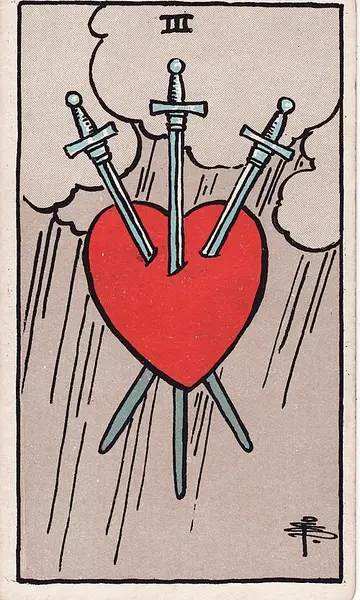
Upright, the Three of Swords speaks to sorrow, grief, and the sharp sting of understanding reality as it is. It often marks an emotional separation, a painful truth that can no longer be avoided, or an experience of betrayal. In the Rider–Waite–Smith tradition, founded with the deck published in 1909, Arthur Edward Waite described this card through removal, absence, delay, division, rupture, and dispersion, noting that it embodies everything the image plainly shows.
More broadly, the card reflects any deep wound to the heart delivered through words, thoughts, or hard realizations. Its guidance is gentle but clear: allow the grief to be felt. Truth may hurt when it first cuts through illusion, but it allows you to heal cleanly.
What does the Three of Swords mean reversed?
When the Three of Swords appears reversed, the emotional weight begins to shift toward recovery, forgiveness, and the release of old pain. It often indicates that the worst of the heartache has been endured, opening up room to mend what was broken and let go of lingering resentment.
At the same time, the reversal can caution against suppressed hurt—wounds that have been pushed down instead of addressed. Waite associated the reversed card with mental alienation, error, loss, distraction, disorder, and confusion. Holding pain inside only clouds your thoughts; letting the rain fall is what allows the sky to clear.
How does the Three of Swords interpret love and relationships?
In matters of love, the Three of Swords addresses heartache or betrayal. It can indicate a difficult conversation, a painful breakup, or the lingering sadness of feeling misunderstood by someone close to you.
The card invites you to look closely at where communication has caused injury or where unresolved grief is being carried. It does not ask you to rush into closing off your heart or forcing a resolution. Instead, it offers room to process your feelings with self-compassion so you can eventually move forward with clarity.
What does the card mean for work and money?
In work readings, the Three of Swords reflects a painful split. This might take the form of dissolving a business partnership, navigating a sharp dispute with colleagues, or facing the disappointing conclusion of a project.
Financially, the card points to a painful financial split or loss, such as a divisive dispute over resources or an unexpected setback. In a reversed position, it highlights gradual recovery after a hurtful dispute, showing that honest assessment and clear agreements can help you rebuild stability.
Does the Three of Swords read as a yes or a no?
In a simple question of direction, the Three of Swords reads as a no. It signals that unresolved hurt, tension, or conflicting viewpoints need your attention before any clear forward movement can happen.
What is pictured on the card and why?
The imagery of the Three of Swords is one of the most direct in the 1909 Rider–Waite–Smith deck. A bright red heart is pierced through by three swords, set against a backdrop of heavy grey storm clouds and falling rain.
Heartbreak is plainly shown, leaving no doubt about the card’s emotional focus. Every detail serves a purpose: the rain represents grief that must be allowed to flow rather than be bottled up, while the storm clouds signify that sorrow is a temporary weather pattern that will pass in time.
What do the number and suit reveal about this card?
The suit of Swords belongs to the element of Air, representing the realm of thoughts, communication, conflict, and decisions. Swords operate in the mind, cutting through confusion with analytical truth.
Across the Minor Arcana, the number three represents growth, collaboration, and first results. Within the intellectual arena of Swords, this stage represents the result of conflicting ideas or unspoken tensions coming to a head. The mental stalemate of the Two of Swords gives way to an undeniable outcome: the truth is spoken, a decision creates a separation, and the mind’s clarity is felt directly in the heart.
What are the esoteric correspondences of the Three of Swords?
In the Golden Dawn system, the Three of Swords bears the title “Lord of Sorrow.” Its astrological correspondence is Saturn in Libra, representing the decan attribution from the Golden Dawn tradition (Book T).
Saturn brings boundary, structure, and sobering realism, while Libra seeks balance, justice, and truth. Paired with the suit element of Air, this combination emphasizes that facing hard facts, while sorrowful, restores equilibrium and cuts away illusions that were unsustainable.
Which cards interact with the Three of Swords?
When the Three of Swords appears alongside the Five of Cups, the theme of heartbreak and grief is deepened. This combination highlights a period of mourning over what has ended or gone wrong. At the same time, it carries an important reminder: even in the presence of sorrow, something still remains. It encourages you to acknowledge your loss without losing sight of the support and possibilities that are still standing.
What are common mistakes when reading the Three of Swords?
A frequent misreading is assuming that the Three of Swords always points to romantic infidelity. In reality, it represents any form of heartbreak, sorrow, or painful truth, including personal disappointments, work conflicts, or family divides.
Another mistake is viewing the sorrow as permanent. While the card does not minimize emotional pain, the imagery makes it clear that clouds and rain are transitory. The hurt is real, but it is a stage of processing, not an endless state.