In tarot, the Eight of Swords represents restriction and self-imposed limits. It reflects moments when you feel trapped, powerless, or frozen by your own thoughts and anxieties, even though the barriers holding you back are far less solid than they appear. At its heart, the card is a quiet invitation to examine your situation: options exist that fear currently hides, and real freedom begins the moment you question the belief that you have no choice.
What does the Eight of Swords mean upright?
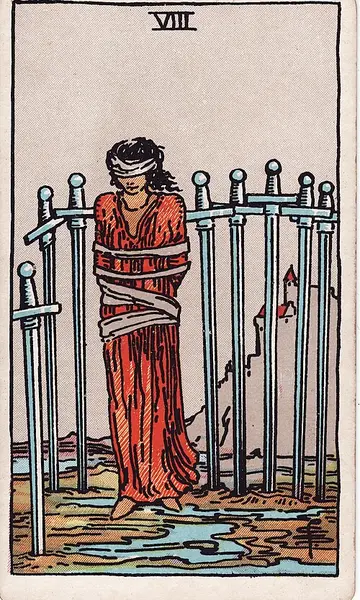
When the Eight of Swords appears upright in a reading, it points to feeling trapped by mental loops, helplessness, and victim thinking. You may feel surrounded by obstacles, convinced that every path forward is blocked and that you lack the ability to change anything. However, tarot treats this as a conversation with your own mind: the paralysis comes from within rather than an inescapable physical prison.
In the Rider–Waite–Smith tradition (first published in 1909), Arthur Edward Waite described this card as signifying bad news, violent chagrin, crisis, censure, and power held in check. Importantly, he noted that this card reflects a temporary confinement rather than lasting bondage. The core advice here is simple and grounding: question the thought that says you have no choice. The limits you experience are kept alive by fear, and when you dare to look directly at that fear, the trap begins to unravel.
What does the Eight of Swords mean reversed?
Reversed, the Eight of Swords signals release, seeing options, and regaining freedom. The bonds that once held your focus narrow begin to loosen. You start stepping out of victim thinking, reclaiming personal agency, and realizing that you hold the power to change direction. Freedom begins by taking off the blindfold and assessing your surroundings with honesty.
Waite noted traditional meanings for the reversal such as disquiet, difficulty, opposition, accident, and treachery—the unforeseen. Moving out of mental confinement often brings temporary unease because confronting reality requires effort and disrupts old coping habits. Even so, the card reversed shows that you are actively finding your way out and stepping into clarity.
What does the card mean in love and relationships?
In relationships, the Eight of Swords points to feeling stuck in the bond. You might feel restricted by unspoken expectations, lingering misunderstandings, or the belief that the dynamic cannot evolve.
This card suggests looking at whether the walls between you are truly fixed or built from internal hesitation. Often, fear of conflict or fear of vulnerability keeps people frozen in place. Acknowledging your own boundaries and speaking honestly can help you see where the room to move has been all along.
What does the card mean at work and with money?
In career contexts, the Eight of Swords reflects feeling constrained though options exist. You may feel locked into a role that drains you or paralyzed when trying to make a professional decision, convinced that stepping forward carries too much risk.
Financially, it mirrors feeling stuck in a job or under heavy debt. While financial challenges are concrete, the card points out where defeatist narratives prevent you from noticing realistic adjustments. Reversed, it signifies finding the way out, restructuring debts, and recognizing pathways to new work.
Does the Eight of Swords mean yes or no?
In a straightforward yes-or-no question, the Eight of Swords reads as a no. It indicates that the situation is currently clouded by mental restriction, self-doubt, or unexamined assumptions that hinder clean, confident progress.
What is pictured on the card and why?
The imagery of the Rider–Waite–Smith deck illustrates psychological restriction with great clarity. A bound and blindfolded woman stands among eight swords stuck upright in muddy ground, with a castle set high on a cliff behind her.
Despite the dramatic scene, the woman’s bonds are loose, and the swords do not form an unbroken wall. Nothing truly holds her in place. The open path is hidden only because she cannot see it through the blindfold. Her feet are free, and she is trapped mostly by her own fears. The scene reminds us that external circumstances rarely have complete control over our capacity to choose our next step.
What do the number and suit reveal about this card?
The suit of Swords governs the element of Air, focusing on thoughts, communication, conflict, and decisions. Swords illustrate how our internal dialogue shapes our experience of the world—either offering intellectual clarity or spinning convincing illusions of helplessness.
The number Eight carries meanings of movement, power, mastery, and work. In the Eight of Swords, that natural drive toward movement runs into mental resistance. Instead of using your mental power to work through challenges, that energy turns inward, producing tension and temporary stagnation.
What are the astrological and esoteric correspondences?
In the Golden Dawn tradition, the Eight of Swords is assigned the title “Lord of Shortened Force.” Its astrological correspondence is Jupiter in Gemini.
Jupiter is the principle of growth and perspective, while Gemini is an Air sign centered on rapid thoughts, information, and everyday communication. When Jupiter’s broad outlook enters Gemini’s busy analytical landscape, thoughts can multiply quickly. Without grounding, this can lead to overthinking, second-guessing, and feeling mentally scattered.
Because the suit corresponds to Air, observing how Air interacts with other elements offers helpful context:
- Air with Fire: Fire brings courage and decisive action to cut through excessive mental rumination.
- Air with Water: Water introduces emotional honesty, helping soften rigid, fearful logic.
- Air with Earth: Earth provides practical grounding, turning abstract worries into tangible, manageable tasks.
- Air with Air: Additional Air can sharpen objective analysis, but it can also trap you in endless intellectual loops if not balanced by action.
What are common mistakes when reading this card?
A common mistake is treating the Eight of Swords as a permanent or inescapable external prison. The bonds are loose and temporary, and the card never depicts a locked door.
Another mistake is assuming that other people are intentionally trapping you. In most readings, the restriction stems primarily from one’s own fear and the unexamined habit of waiting for outside rescue.
Try it yourself
- What belief am I holding that makes me feel like I have no options right now?
- Where am I letting fear convince me that my hands are completely tied?
- What small, realistic step can I take today to test whether this restriction is real?
- How can I gently shift my self-talk from helplessness to personal choice?