The Seven of Swords represents strategy, stealth, evasion, and acting alone. When this card appears, it often points to navigating a complex situation through tactical thinking, keeping your plans private, or dealing with hidden motives and partial honesty. Rather than predicting events, it invites a calm conversation with yourself about how you approach problem-solving, boundaries, and personal integrity.
What does the Seven of Swords mean upright?
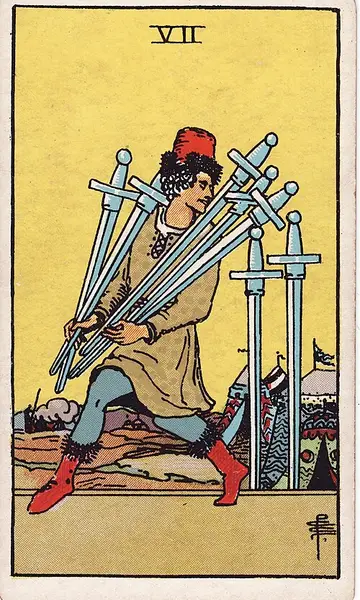
Upright, the Seven of Swords highlights stealth, strategy, and evasion. It speaks of acting independently, relying on cunning, and sometimes navigating deceit. In the Rider–Waite–Smith tradition (published in 1909), Arthur Edward Waite associated this card with design, attempt, wish, hope, and confidence, but also noted the presence of quarrelling and a plan that may fail.
When interpreting this card, look closely at the role being played: it could represent your own clever plan, someone else working behind the scenes, or simply a moment requiring discretion. The core advice of the Seven of Swords is to be strategic but honest, and to check what is being hidden before taking your next step.
What does the Seven of Swords mean reversed?
Reversed, the Seven of Swords signals exposure, conscience, coming clean, or being caught. The concealed plan or private agenda is brought into the open or abandoned altogether. Waite connected this reversal with good advice, counsel, and instruction, alongside the hazards of babbling and slander.
In this position, internal conscience often takes over. The pressure of keeping secrets dissolves, or a quiet compromise is finally acknowledged. When evasion no longer serves, honesty becomes the best strategy available.
How does the Seven of Swords apply to love and relationships?
In readings about love, the Seven of Swords points to secrecy or a hidden agenda. It suggests that someone may not be sharing their full truth, slipping away from difficult conversations, or managing emotional distance through quiet withdrawal.
Rather than assuming the worst, treat this card as an invitation to examine where openness has broken down. It asks you to reflect on whether you or your partner feel unable to speak freely, and what fears might be driving the need for emotional concealment.
What does the Seven of Swords mean for work and money?
In professional situations, the Seven of Swords indicates self-reliant tactics and reminds you to watch for dishonesty. It often appears when navigating competitive environments where direct confrontation is ineffective and clever, independent maneuvers are necessary to protect your interests.
Financially, the card advises vigilance: watch for theft, fraud, or hidden terms in contracts and agreements. Here, thoughtful strategy beats brute force. If the card appears reversed in a financial reading, deceit is often exposed, or something that was lost or taken may be returned.
Is the Seven of Swords a yes or no?
In a yes-or-no question, the Seven of Swords reads as a no. Its themes of evasion, incomplete information, and unstable effort suggest that the foundation is not yet solid enough for a straightforward move forward.
What is pictured on the card and why?
In the Rider–Waite–Smith deck illustrated by Pamela Colman Smith, a man tiptoes away from a military camp carrying five swords in his arms, leaving two swords planted behind him in the ground. As he slips away, he glances back over his shoulder with a subtle smile.
This imagery illustrates stealth, strategy, and getting away with something. The cluster of tents represents the group or collective he is walking away from. The two blades left behind highlight what he could not take with him, symbolizing compromise and the loose ends that tactical shortcuts often leave in their wake.
What do the number seven and the suit of Swords reveal?
The suit of Swords governs the realm of thoughts, communication, conflict, and decisions, aligned with the element of Air. It reflects how we process truth, analyze our environment, and communicate our choices.
The number seven belongs to the Sevens of the Minor Arcana, which represent reflection, testing, and assessment. Within the intellectual arena of Swords, this testing phase pushes you to evaluate your methods. It asks whether your current tactics are truly sustainable or merely a short-term bypass around a necessary challenge.
What are the astrological and esoteric correspondences of the Seven of Swords?
In the Hermetic Order of the Golden Dawn, the Seven of Swords bears the title “Lord of Unstable Effort.” It corresponds to the suit element of Air.
Its astrological attribution is the Moon in Aquarius. This decan pairing brings together the shifting, intuitive nature of the Moon with the detached, innovative mindset of Aquarius. Esoterically, it reflects the tension between intellectual independence and emotional vulnerability, showing how strategic calculation can sometimes be used to guard personal feelings.
Which cards strengthen or change the Seven of Swords?
When the Seven of Swords appears alongside The Moon, the themes of deceit and a hidden agenda are notably heightened. The shadowy, indistinct atmosphere of The Moon magnifies the evasiveness of the Seven of Swords, indicating that critical facts may be obscured and that clarity requires looking beyond surface appearances.
What are common mistakes when reading the Seven of Swords?
A frequent misreading is assuming that the Seven of Swords always means a cheating partner in a relationship. While it does highlight secrecy, it often represents necessary privacy, a delicate personal boundary, or simply an independent plan.
Another mistake is assuming the card always refers to someone else acting against you. Very often, the card reflects you: slipping away from an exhausting conflict, solving a problem through clever workaround, or deciding to act alone rather than waiting for consensus.
Try it yourself
- Where in my life am I avoiding a direct conversation, and what am I trying to protect?
- How can I use smart strategy to solve my current problem while staying completely honest?
- What details or hidden terms do I need to review before moving forward?
- Am I quietly pulling away from a situation that I should address directly?