In a tarot reading, the Nine of Swords represents anguish of the mind: anxiety, sleeplessness, guilt, worry, and despair. It reflects those quiet, overwhelming hours when thoughts loop endlessly, reminding us that while mental pain feels sharp and genuine, the fear lives primarily in our perception rather than in external events.
What does the Nine of Swords mean upright?
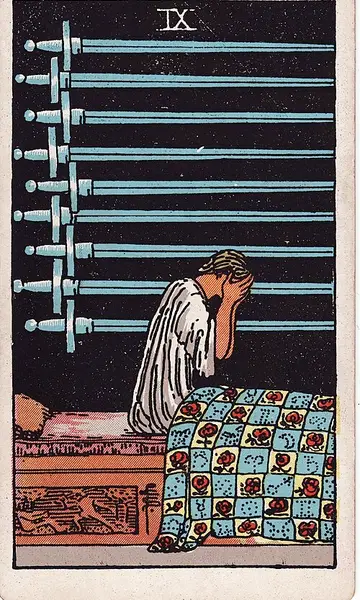
When upright, the Nine of Swords points directly to anxiety and nightmares in the night, accompanied by worry and guilt. It captures the psychological weight of insomnia, where problems seem insurmountable in the quiet dark.
Historically, in the Rider–Waite–Smith tradition published in 1909, Arthur Edward Waite offered a grim evaluation of this card, associating it with death, failure, miscarriage, delay, deception, disappointment, and complete desolation. However, modern readers understand the card differently: this torment is mostly in the mind and can be relieved. Rather than indicating an inevitable disaster, it reveals an overloaded mind exhausted by its own fears, offering a compassionate nudge to pause and step away from catastrophic thinking.
What does the Nine of Swords mean reversed?
Reversed, the Nine of Swords shows a shift in how fear operates: worries begin easing, help is sought, or hidden fears surface into conscious awareness. Bringing what is concealed into the open often strips it of its power.
Waite linked the reversal to imprisonment, suspicion, doubt, reasonable fear, and shame. In a modern reading, the core message is grounded in release: saying the fear out loud makes it smaller. Talk to someone, because fears shrink when spoken. When you stop isolating yourself with your thoughts, the imaginary weight begins to dissolve.
How does the Nine of Swords apply to love?
In matters of the heart, the Nine of Swords reflects anxiety and fear about the relationship. It often signals overanalyzing a partner’s words, dreading abandonment, or allowing old emotional wounds to create imaginary conflict.
This card suggests that the primary struggle in love right now is internal rather than between two people. Unexpressed guilt, unspoken doubts, or worst-case scenarios can cause real emotional distress. Opening an honest, calm conversation helps ground your connection in what is actually happening instead of what your anxiety imagines.
How does the Nine of Swords apply to work and money?
At work, the Nine of Swords indicates overthinking and stress. It represents imposter syndrome, late-night worrying over deadlines, or mentally magnifying small workplace challenges until they feel overwhelming.
Financially, it reflects money worries keeping you up at night. You might find yourself running catastrophic financial scenarios that disturb your rest. When reversed, the worst fear proves smaller in daylight. Looking directly at realistic numbers, asking for professional guidance, or drafting a concrete plan will reveal that daylight solutions exist.
Does the Nine of Swords read as a yes or a no?
In questions seeking a simple direction, the Nine of Swords reads as a no. It indicates that current thoughts are clouded by distress, worry, or exhaustion. Making decisions from a state of mental tension rarely brings clarity; this card suggests resting and regaining calm before moving forward.
What is pictured on the card and why?
In the Rider–Waite–Smith deck, a woman sits up in bed with her face buried in her hands. Behind her in the pitch-black room, nine swords hang horizontally, mounted on the wall like a heavy cage. Over her knees lies a quilt patterned with red roses and astrological signs.
Every detail in the illustration highlights the nature of mental anguish. The swords do not touch her; the fear lives in the mind, though the pain is real. The darkness of the room emphasizes the feeling of psychological isolation, while the bed frames the experience around nightmares and midnight wakefulness.
What do the number and suit reveal about this card?
The suit of Swords corresponds to the element of Air, which rules thoughts, communication, conflict, and decisions. Swords illustrate the power of the intellect, which can either cut through confusion or turn inward and cause suffering.
The rank of Nines signifies near completion, solitude, and fruition. When the mental energy of Swords approaches completion, solitude can turn into deep isolation within one’s own head. The Nine of Swords represents thoughts reaching their absolute peak of intensity right before the cycle must transform.
What are the astrological and Golden Dawn correspondences?
In the hermetic system developed by the Hermetic Order of the Golden Dawn, the Nine of Swords carries the title Lord of Despair and Cruelty.
Its astrological attribution is Mars in Gemini, with the suit element being Air. This alignment reflects the abrasive, driving friction of Mars channeled through the quick, restless, communicative sign of Gemini. The result is a sharp, hyperactive mind that attacks itself with racing thoughts and nervous energy.
Which cards strengthen or change the Nine of Swords?
Certain combinations clarify the direction of this card’s intense mental atmosphere:
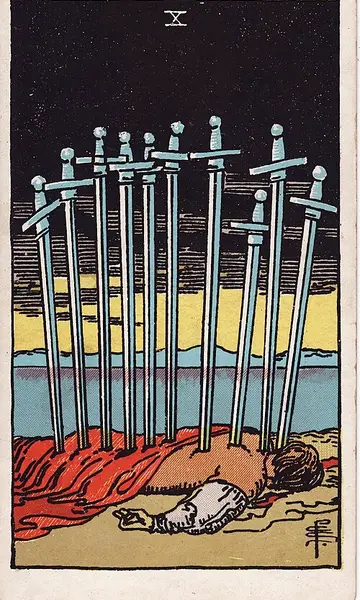
- Nine of Swords + Ten of Swords: This pairing speaks of the worst night; the dawn follows. It marks the absolute end of a painful mental ordeal. When the spiral reaches its absolute limit, the suffering collapses under its own weight, making room for a new morning.
What are common mistakes when reading the Nine of Swords?
- Viewing it as an external prediction: The Nine of Swords is not a prophecy that the feared event will happen; it is anxiety. Treating it as a forecast only feeds the panic it seeks to illuminate.
- Equating mental struggle with failure: It is not weakness; it is an overloaded mind that needs help. Experiencing sleeplessness or dread is simply a signal that the mind requires rest, grounding, and compassionate support.