The Five of Swords represents a hollow victory—a situation where someone may have won an argument or a clash, but at a painful cost. It speaks to tension, selfishness, defeat, and the bitter aftermath left behind when proving a point or winning at all costs matters more than mutual respect. At its heart, this card is an invitation to pause and look closely at the true price of our conflicts.
What is the upright meaning of the Five of Swords?
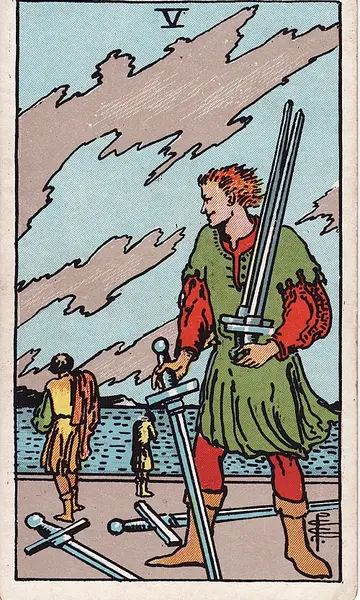
In an upright position, the Five of Swords points to conflict, tension, and a victory that leaves bitterness in its wake. It often reflects an environment where people act purely out of self-interest, using sharp tactics or disregard for others to get what they want. In the Rider–Waite–Smith tradition, published in 1909, Arthur Edward Waite associated this card with degradation, destruction, revocation, infamy, dishonour, and loss.
The core advice here is straightforward: pick your battles, because not every win is worth having. Standing over an opponent with all the spoils might feel like an accomplishment in the heat of the moment, but the card asks whether the damage done to trust, relationships, and self-respect was truly worth the triumph.
What does the Five of Swords mean when reversed?
When reversed, the Five of Swords indicates that a conflict is shifting into a new stage, though whether it heals or festers depends on how you handle it. On one hand, it represents reconciliation and the wisdom of laying down your swords. You may decide that walking away from a pointless dispute is far healthier than continuing to trade blows.
On the other hand, the reversed card can signal lingering resentment that keeps old wounds open long after the fight has ended. Waite retained the central themes of the upright card when reversed, adding connotations of burial and mourning. It invites you to finally release the grudge, stop replaying past grievances, and let the unresolved struggle rest.
How does the Five of Swords show up in love?
In relationship readings, the Five of Swords highlights an argument that nobody wins. It illustrates dynamics where conversations become battlegrounds, and partners focus on scoring verbal points rather than understanding each other.
Even if one person “wins” the dispute through sharper words or emotional pressure, the victory is hollow. The underlying connection is weakened, replaced by distance, defensiveness, and lingering hurt. The card asks both people to step back from the urge to be right and consider what is truly best for the partnership.
What does the card mean for work and money?
In professional situations, the Five of Swords warns of toxic competition. It often reflects an atmosphere marked by office politics, cutthroat rivalry, or colleagues who look out only for themselves at the expense of teamwork.
When it comes to finances, an upright Five of Swords can suggest a win that comes at the expense of valuable working relationships, or experiencing a financial loss due to someone else’s sharp, unscrupulous practices. Reversed, it points toward finding a resolution: reaching a settlement, cutting your losses, or deciding that walking away from an unpromising negotiation is wiser than funding a prolonged battle.
Is the Five of Swords a yes or a no?
When asking a direct question, the Five of Swords reads as a no. It cautions that pursuing the situation right now is likely to generate unnecessary friction, regret, or hidden costs.
What is pictured on the card and why?
In the Rider–Waite–Smith deck, illustrated by Pamela Colman Smith, a smirking man gathers three swords into his arms while glancing back over his shoulder. In the distance, two beaten figures walk away toward the open sea, their heads bowed in grief, while two more swords lie abandoned on the ground.
Above them, the sky is jagged and windy. These torn clouds visually represent conflict in the air—sharp words and turbulent thoughts. The swords left behind in the dirt symbolize defeat and lost honour. The entire composition emphasizes that while the central figure holds the weapons, the scene is empty of genuine celebration.
What do the number and suit reveal about this card?
The suit of Swords governs the realm of thoughts, communication, conflict, and decisions, aligned with the element of Air. It deals with how we reason, how we express our truths, and how misunderstandings arise.
In tarot numerology, the Fives represent conflict, loss, instability, and change. When the mental clarity of the Swords suit encounters the disruptive energy of the number five, the result is friction in thought and speech: ideological clashes, defensive reactions, and the destabilizing fallout of unmanaged pride.
What are its astrological and esoteric correspondences?
In the Golden Dawn system, the Five of Swords bears the title “Lord of Defeat.” Its astrological attribution is Venus in Aquarius, and its suit element is Air.
This decan pairing places the relational, harmony-seeking nature of Venus inside the detached, analytical realm of Aquarius. It highlights what happens when intellectual principles or fixed mental stances override human empathy: logic becomes chilly and uncompromising, severing the warmth that sustains relationships.
Which card pairings influence its meaning?
When the Five of Swords appears alongside the Five of Wands, the reading points to open conflict—a fight where nobody wins. Where the Five of Wands reflects competing egos, noisy arguments, and everyday friction, the Five of Swords deepens the dispute into something colder and more divisive, confirming that continuing the struggle will only exhaust everyone involved without bringing closure.
What are common mistakes when reading this card?
A frequent mistake is assuming the Five of Swords automatically means you are the one who loses. The card does not state that you are bound to fail; instead, it asks you to reflect on which figure in the image you currently embody. Are you the figure walking away bruised, or the one gathering the swords at the expense of others?
Another misreading is treating this card as a depiction of a fair contest. The Five of Swords portrays an unbalanced situation where victory is ultimately hollow and the costs outweigh the rewards.
Try it yourself
- Where in my life am I prioritizing winning an argument over preserving a connection?
- Is the conflict I am currently engaged in truly worth what it costs me?
- How can I gracefully lay down my swords and step away from an unproductive dispute?
- What boundaries do I need to set to protect myself from toxic competition around me?