The Six of Swords represents a transition: moving from troubled waters toward calmer shores. In tarot, this card reflects a quiet journey of recovery and mental clarity, signaling that while difficulties may have left an impression, the most turbulent stretch is behind you.
What does the Six of Swords mean upright?
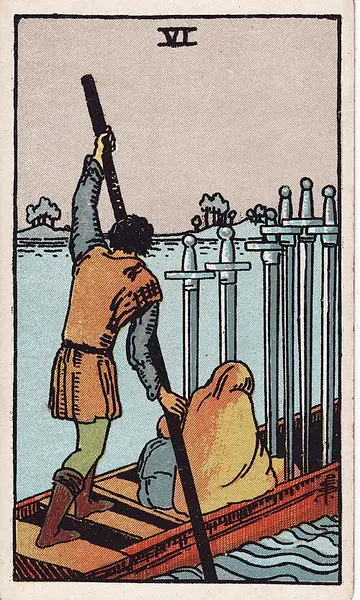
Upright, the Six of Swords is about transition, journeying, and moving on. It suggests leaving behind discord or stress to find a more peaceful state of mind. This card does not promise an instant arrival at your final destination; rather, it marks the passage itself. Healing happens gradually as you put distance between yourself and past conflicts.
In the Rider–Waite–Smith tradition, Arthur Edward Waite described this card as a journey by water, a route, an envoy, and an expedient way out. The Hermetic Order of the Golden Dawn titled it the “Lord of Earned Success,” emphasizing that this passage is earned through deliberate effort and conscious choices. The card’s practical advice is simple: move on gently, and remember that you do not have to have arrived yet to be on the right track.
What does the Six of Swords mean reversed?
When reversed, the Six of Swords indicates that the crossing has stalled. You may feel stuck, unable to leave an unhealthy environment, or burdened by old baggage that you continue to carry along. It can also point to rough water ahead if an underlying issue remains unaddressed.
Waite noted traditional associations for the reversal such as declaration, confession, publicity, and even a proposal of love—moments where hidden thoughts surface into the open. In a personal reading, a reversed Six of Swords is an invitation to examine what is delaying your progress. The core guidance is to finish the crossing rather than remaining stranded midway.
How does the Six of Swords read in love and relationships?
In love readings, the Six of Swords centers on leaving drama behind and allowing slow healing to take place. If a relationship has weathered arguments or intense stress, this card points to a period of cooling down, where both partners choose peace over conflict.
For someone who is single, it reflects a conscious step away from past relational wounds. It is not about rushing into something new, but rather giving yourself the emotional space to recover so that past patterns do not follow you into the future.
What does the card say about work and money?
In professional inquiries, the Six of Swords often signifies a relocation or a transition. This could mean switching departments, changing careers, or adopting a new working style that brings relief from workplace tension.
Financially, the card indicates a gradual improvement or a move made for financial reasons. When reversed, it warns that unresolved debts or lingering obligations may follow you. Addressing these financial details directly ensures that your fresh start is built on solid ground.
Is the Six of Swords a yes or no card?
In a straightforward yes-or-no question, the Six of Swords reads as a yes. It reflects forward movement, constructive solutions, and steady progress toward a calmer situation.
What is pictured on the card and why?
In the Rider–Waite–Smith deck (published in 1909, illustrated by Pamela Colman Smith), the imagery tells a clear story. A ferryman poles a boat carrying a cloaked woman and a child toward a far shore. Six swords stand upright in the boat alongside them.
The water beside the boat shows ripples and rough patches on one side, while the water ahead is smooth and still. This visual contrast captures a passage from trouble to calmer waters. The swords travel with the passengers, showing that sorrow and memories are carried along, but they feel lighter as the calm water ahead promises peace.
What do the number and suit reveal?
The suit of Swords governs the realm of thoughts, communication, conflict, and decisions. It is connected to the intellect and how we process our experiences.
The number Six (Sixes) represents harmony, exchange, and moving to something better. In the suit of Swords, this combination produces a welcome moment of relief: the active struggles seen in earlier cards give way to balanced reasoning, compromise, and constructive movement forward.
What are the card’s astrological and esoteric correspondences?
According to the Golden Dawn system (recorded in Book T), the Six of Swords holds the following correspondences:
- Suit Element: Air, representing the mental plane, intellect, and communication.
- Golden Dawn Title: Lord of Earned Success.
- Astrology: Mercury in Aquarius. Here, Mercury’s quick intellect combines with the forward-looking, innovative perspective of Aquarius, fostering objective problem-solving and the ability to envision a calmer future.
How does the Six of Swords combine with other elements?
The Six of Swords belongs to the element of Air. When reading it alongside other suits, observing elemental dynamics helps clarify the nature of your transition:
- Air and Fire (Wands): Air fuels Fire, turning mental decisions into energetic movement. Transitions gain motivation, purpose, and creative drive.
- Air and Water (Cups): Air cools and analyzes the emotional currents of Water. This pairing supports emotional healing by bringing perspective and clarity to deep feelings.
- Air and Earth (Pentacles): Air meets tangible reality, grounding mental transitions into practical adjustments, such as physical relocation or realistic financial plans.
- Air with Air (Swords): The focus on thoughts, communication, and perspective intensifies. It encourages clear-eyed objectivity, while reminding you not to over-intellectualize your healing process.
What are common mistakes when reading this card?
A frequent misconception is viewing the Six of Swords as running away or an act of avoidance. In reality, it is a healing transition—a deliberate choice to step away from fruitless conflict in order to preserve your well-being.
Another common mistake is assuming the card must mean literal travel across water. While it can reflect physical travel or relocation, it just as frequently describes an internal shift, a change of mindset, or a transition in circumstances.