The Four of Swords represents intentional rest, retreat, and mental recovery after a period of tension. It is not an ending, but a conscious pause—a quiet space to step back, calm the mind, and regain clarity before taking your next step.
What is the upright meaning of the Four of Swords?
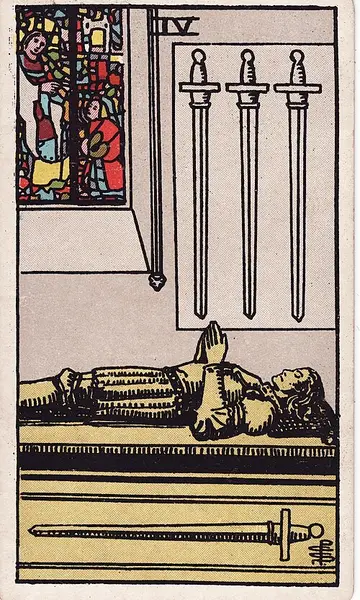
Upright, the Four of Swords signifies rest and retreat, recovery, and meditation after strain. If you have been navigating a stressful situation, difficult conversations, or mental burnout, this card suggests that the most constructive response right now is to stop and rest.
In the notes of Arthur Edward Waite, this card carries themes of vigilance, retreat, solitude, a hermit’s repose, and exile, directly mirroring the tomb motif in the image. It favors convalescence, stepping back, and calling a temporary truce with whatever has been draining your focus. Rest now; recovery is not wasted time. Stepping away from the noise gives your thoughts room to settle so you can return with renewed strength.
What does the Four of Swords mean reversed?
Reversed, the card suggests that the period of rest has either ended or is being actively refused. In many readings, it points to restlessness and burnout—pushing yourself to keep moving when your mind and body are demanding quiet.
Alternatively, it can indicate a return to action after a necessary lull. Waite connected the reversed card with wise administration, circumspection, economy, precaution, and even organizing affairs such as a will. If you are re-entering daily demands after a retreat, return gradually rather than rushing back in all at once.
How does the Four of Swords apply to love and relationships?
In relationship readings, the Four of Swords highlights taking time apart to heal. When tensions run high, trying to force an immediate resolution often creates more friction rather than bringing peace.
This card represents a gentle truce. Giving each other breathing room allows both people to process their thoughts calmly without reactivity. It does not signify an abandonment of the connection, but rather a healthy pause to recover emotional equilibrium before reopening the dialogue.
What does the Four of Swords mean for work and money?
In professional situations, the advice of the Four of Swords is direct: take a break and recharge. Depleted energy clouds strategic thinking. Stepping back from intense projects or career decisions gives your mind the clarity it needs to reset.
Financially, this card suggests a pause in finances. Do not make major financial decisions or sign significant agreements while depleted. When reversed, it points toward getting back to work or exercising careful economy and caution with your money.
Does the Four of Swords mean yes or no?
In a yes-or-no reading, the Four of Swords reads as a maybe. It indicates that the current moment is better suited for stepping back and gathering information than making a firm choice. Once your mind is clear and rested, the direction will become obvious.
What is pictured on the card and why?
In the Rider–Waite–Smith tradition (deck published in 1909), the card shows the effigy of a knight lying in prayer on a tomb in a quiet church. Three swords hang point-down on the wall above him, while a fourth sword is carved along the side of the tomb. A stained-glass window illuminates the quiet space nearby.
This imagery embodies rest and retreat after strife. The carved effigy represents the complete stillness needed for recovery, while the stained-glass window suggests grace and quiet reflection. The three hanging swords honor past struggles that are now set aside, while the single sword along the tomb remains close at hand for when the knight is ready to rise again.
What do the number four and the suit of Swords represent?
The suit of Swords centers on thoughts, communication, conflict, and decisions. It reflects the mental landscape, where active thinking can easily slip into anxiety or argument.
The rank of Fours represents stability, structure, or stagnation. When stability meets the mental energy of Swords, it produces a structured sanctuary—a deliberate pause where mental noise is filtered out. If held for too long, however, that protective structure can turn into stagnation or unnecessary isolation.
What are the card’s astrological and esoteric correspondences?
Under the Golden Dawn correspondences, the Four of Swords is titled the “Lord of Rest from Strife.”
Its suit element is Air, governing the intellect and perception. Its astrological correspondence is Jupiter in Libra. Libra seeks balance, peace, and fair resolution, while Jupiter contributes perspective, benevolence, and wisdom. Together, they create a calm environment that supports mental balance and peaceful recuperation.
How does the Four of Swords interact with other elements?
As an Air card, the Four of Swords brings a cool, stabilizing presence to the cards around it:
- With Fire: Fire seeks fast movement and expression. The stillness of Air acts as a container, cooling impulsive reactions and preventing burnout.
- With Water: Water carries deep emotional currents. The calm clarity of Air helps settle turbulent feelings so healing can occur gently.
- With Earth: Earth deals with tangible resources and routines. A mental pause ensures that material plans are based on sound reflection rather than stress.
- With other Air cards: Multiple Swords amplify thought and communication. The Four provides a necessary refuge from overthinking, though too much isolation can lead to withdrawal.
What are common mistakes when interpreting this card?
Because the illustration features a tomb, one common mistake is assuming the card signals death or physical illness. The Four of Swords is not death or illness by default; it is rest and recuperation, using the sanctuary setting to express undisturbed peace.
Another frequent misreading is viewing the pause as laziness. It is not laziness; it is a needed retreat. Taking time to step back is what sustains your ability to act thoughtfully later on.
Try it yourself
- Where in my life do I need to step back and recharge before moving forward?
- What conflict or mental pressure can I put on pause today to regain clarity?
- Am I allowing myself adequate recovery time, or am I rushing back into action prematurely?
- How can I carve out a quiet space to restore my mental balance?