In tarot, The Hanged Man represents a voluntary pause, surrender, and gaining a fresh perspective by letting go of control. As a card of the Major Arcana, it highlights a significant life theme and turning point that goes beyond everyday routines. Rather than trying to force progress through willpower, this card invites you into a calm conversation with yourself, suggesting that clarity and deeper understanding arrive when you willingly step back and look at your world from an entirely different angle.
What is the upright meaning of The Hanged Man?
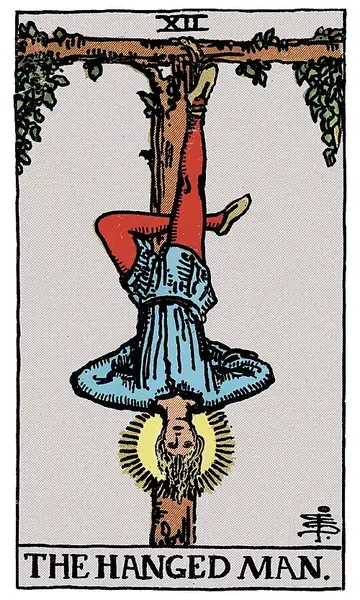
The upright Hanged Man indicates a voluntary suspension. It reflects a conscious choice to pause, release your grip on an outcome, and allow yourself to see an existing situation from an unexpected viewpoint. In the Rider–Waite–Smith tradition (first published in 1909), Arthur Edward Waite associated this card with wisdom, discernment, trials, sacrifice, intuition, and prophecy.
Progress under The Hanged Man does not come from pushing forward or struggling against obstacles. Instead, real growth happens through surrender. Making a small, deliberate sacrifice of your immediate comfort, timeline, or pride can purchase invaluable insight. The core advice of the card is simple: stop struggling for a moment and look at things the other way up.
What is the reversed meaning of The Hanged Man?
When reversed, the quiet pause of The Hanged Man loses its constructive purpose. Rather than a mindful surrender, the reversal points to stalling, chronic indecision, pointless martyrdom, or stubborn resistance against a needed shift in perspective. You might find yourself sacrificing your energy or time for something that yields no genuine wisdom in return.
Waite noted themes of selfishness and the crowd in the reversal, evoking an image of slipping back into the unthinking mass rather than following your own path. A reversed Hanged Man asks you to make a conscious choice: either fully accept the pause and learn what it has to teach you, or actively bring the stalling to an end and move forward.
How does The Hanged Man appear in love and relationships?
In readings about love, The Hanged Man suggests a period of waiting and seeing things differently. It often marks an emotional pause where pushing for immediate answers or ultimatums will only create friction.
This card invites you to suspend expectations and look at your relationship from your partner’s point of view. By letting go of the need to always be right or to steer every dynamic, you create room for mutual understanding. Sometimes love requires patience and the willingness to let things unfold without immediate resolution.
How does The Hanged Man apply to work and money?
At work, The Hanged Man shows that projects, decisions, or career changes are currently on hold. Rather than treating this stillness as a failure, use it as a deliberate opportunity to reconsider your strategy before taking your next step. Review your plans thoroughly while the momentum is quiet.
Regarding finances, funds or business deals are likely suspended. The card advises against trying to force a contract, purchase, or investment right now. When reversed, it warns of an unproductive, stalled situation or a sacrifice that brings nothing back, reminding you to stop pouring resources into endeavors that do not serve you.
Does The Hanged Man mean yes or no?
In questions seeking a simple answer, The Hanged Man reads as a maybe. It signifies that the conditions surrounding your inquiry are still suspended and that the answer depends on your willingness to pause and alter your perspective before moving forward.
What is pictured on the card and why?
In the Rider–Waite–Smith deck, drawn by Pamela Colman Smith, a young man hangs upside down by one foot from a living T-shaped wooden gallows. His free leg is bent at the knee, crossing behind the other to form a subtle cross, while his hands are held calmly behind his back.
Every detail in this imagery reinforces willing surrender rather than suffering. The wood of the tree is living and bearing leaves, indicating that this suspension is fertile and purposeful. Most tellingly, a luminous golden halo radiates around the figure’s calm, peaceful face. This halo signifies the illumination and quiet insight that arrive the moment you stop fighting the present moment.
What are the esoteric correspondences of The Hanged Man?
The Hanged Man is Major Arcana card 12. In the Hermetic Order of the Golden Dawn, it holds the title “The Spirit of the Mighty Waters.” It is placed on Path 23 on the Tree of Life, connecting the Sephirah Geburah (Strength) with Hod (Splendor).
Its Hebrew letter correspondence is Mem, meaning water. In the Golden Dawn system, the astrological attribution for The Hanged Man is Water (with Neptune attributed to it in later modern systems). The element of the card is Water, a modern convention derived from the Golden Dawn framework that is used to evaluate elemental dignities between cards during a reading.
Which cards strengthen or change The Hanged Man?
The Hanged Man pairs significantly with Death. When these two cards appear together, The Hanged Man’s process of letting go and yielding control directly prepares the ground for Death’s natural ending and profound transformation. The voluntary pause of the twelfth card makes the deep, renewing shift of the thirteenth card possible.
What are common mistakes when reading The Hanged Man?
A frequent misreading of The Hanged Man is viewing the card as an image of execution, betrayal, or punitive suffering. The card does not depict punishment or physical distress; it portrays a chosen, voluntary suspension.
Another common error is equating the card with helpless victimhood. The figure hangs with a serene expression and a halo of illumination, showing that the pause is purposeful and the sacrifice is fully self-directed.
Try it yourself
To explore how The Hanged Man applies to your current life, you can bring questions like these to the bot: