Justice represents fairness, truth, accountability, and the clear principle of cause and effect. As a card of the Major Arcana, it highlights a big life theme and a turning point where choices carry lasting weight and matters go beyond the everyday. Rather than predicting what will happen, Justice invites a calm, clear conversation with yourself about how past actions have shaped your present, urging you to weigh your choices on their true merits and act with integrity.
What does Justice mean upright?
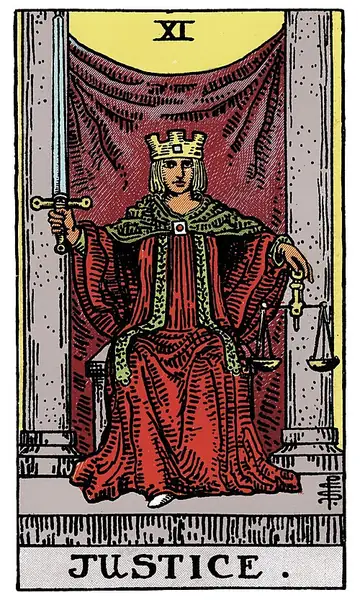
Upright, Justice indicates that a matter is being evaluated and settled with fairness and equity. It stands for truth, impartial assessment, and accountable decisions. In the Rider–Waite–Smith tradition, whose deck was published in 1909, Arthur Edward Waite described this card as representing equity, rightness, probity, and the eventual triumph of the deserving side in law.
When this card appears, it encourages you to look squarely at the facts without rationalisation or blame. It highlights contracts, ethical questions, and formal resolutions, indicating that an honest and balanced approach will lead to the best possible outcome. The central advice of Justice upright is to acknowledge your own contribution to the situation, make thoughtful and responsible choices, and treat everyone involved fairly.
What does Justice mean reversed?
When reversed, the scales tip out of balance. Justice reversed points to unfairness, bias, dishonesty, or an attempt to dodge accountability. It often indicates that someone is refusing to take responsibility, or that a situation is clouded by partiality, prejudice, or unresolved legal complications.
Waite associated the reversed card with the law in all its branches, legal entanglements, bigotry, bias, and excessive severity. On an inner level, reversed Justice frequently reflects judging yourself too harshly. Instead of self-reproach, it calls for gentle objectivity: look at where things went off balance, own whatever part belongs to you, and take practical steps to restore fairness without punishing yourself or others.
How does Justice show up in love?
In love and relationships, Justice emphasizes honesty, mutual respect, and emotional equilibrium. It often reflects the natural consequences of past actions and established relationship habits.
When this card appears in a relationship reading, it invites both people to communicate openly and treat each other as equals. If challenges exist, Justice suggests examining what each partner contributes to the dynamic rather than pointing fingers. Balanced partnerships are built on mutual accountability, where each person takes responsibility for their words and actions.
How does Justice apply to work and money?
In work matters, Justice is directly tied to contracts, legal affairs, and fair dealing. It is an encouraging sign when negotiating agreements, handling formal business procedures, or resolving workplace disputes, provided everything is conducted ethically and transparently.
Financially, Justice upright points to balanced exchanges, fair settlements, and honoring financial obligations. Reversed, it warns of unbalanced terms, dishonest dealings, or potential legal troubles. In money questions, reversed Justice gives clear counsel: read the small print carefully, clarify every expectation, and avoid entering agreements that feel one-sided or murky.
Does Justice mean yes or no?
When looking for a direct answer, Justice reads as a maybe. The card does not hand down an easy outcome. Instead, it indicates that the result depends entirely on the actions taken, the facts of the case, and whether you proceed with fairness and integrity.
What is pictured on the card and why?
In the Rider–Waite–Smith deck published in 1909, artist Pamela Colman Smith depicted Justice as a crowned figure in a vibrant red robe seated between two solid stone pillars, framed by a purple veil. This setting represents an impartial seat of judgment where matters are thoroughly weighed before any decision is made.
In the figure’s right hand is an upright, double-edged sword, symbolizing the mental clarity that cuts through confusion to reveal the plain truth. In the left hand rests a pair of golden scales, representing fairness, equity, and the careful weighing of deeds. At the base of the robe, a single white shoe emerges—a subtle reminder that balanced judgment must not remain theoretical; it is meant to lead directly into grounded, practical action.
What are the astrological and esoteric correspondences of Justice?
The correspondences for Justice come from the Hermetic Order of the Golden Dawn:
- Astrological Sign: Libra, the sign of the scales (Golden Dawn attribution).
- Element: Air. Plainly stated, the element is a modern convention derived from the Golden Dawn, where a zodiac card takes the element of its sign. In tarot readings, this element is used to interpret elemental dignities between cards.
- Golden Dawn Title: The Daughter of the Lords of Truth; the Ruler of the Balance.
- Hebrew Letter: Lamed, meaning “ox-goad.”
- Tree of Life Path: Path 22, connecting the sephirot Geburah and Tiphareth.
- Rank and Number: Major Arcana 11.
Which cards strengthen or change Justice?
Certain combinations highlight specific facets of Justice:
- Justice and Judgement: This pairing indicates a definitive verdict or a significant legal or moral reckoning, marking a moment where past actions meet their conclusive resolution.
- Justice and the Ace of Swords: The Ace of Swords amplifies the card’s analytical energy, bringing sharp legal clarity, transparent communication, and an undeniable revelation of truth.
What are common mistakes when reading Justice?
A frequent misreading of Justice is treating it as an emblem of punishment. Justice is not about vengeance or retribution; it simply reflects cause and effect, natural consequences, and personal accountability.
Another common error is assuming that Justice will automatically side with you. The card does not validate someone simply because they asked the question. Justice is entirely impartial and favours whoever is in the right based on the facts.