The Wheel of Fortune represents the natural rhythm of change, recurring cycles, and pivotal turning points. In tarot, Major Arcana cards highlight big life themes and moments that go beyond the everyday routine. When this card appears, it invites you into a calm conversation with yourself about how you respond to life’s natural shifts, encouraging adaptability as circumstances evolve.
What is the upright meaning of the Wheel of Fortune?
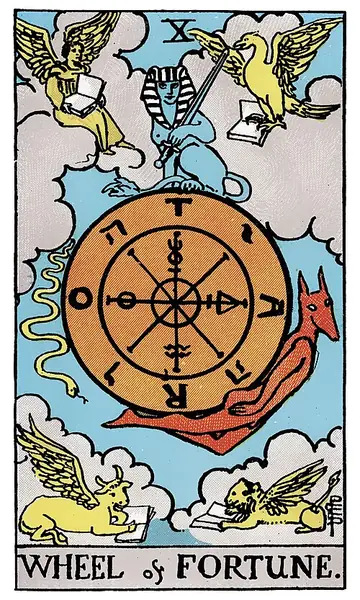
In an upright reading, the Wheel of Fortune signals a turning point. Cycles are shifting, bringing unexpected turns, lucky breaks, and fresh momentum. Because life naturally moves in rhythms of rise and renewal, this card often coincides with opportunities that open up outside your usual planning.
In the Rider–Waite–Smith tradition (first published in 1909), Arthur Edward Waite associated this card with fortune, success, elevation, and unexpected benefit. The core advice of the upright Wheel is to ride the turn: adapt to the shifting landscape rather than clinging to how things used to be, and take practical action while the momentum is on your side.
What does the Wheel of Fortune reversed mean?
When reversed, the Wheel of Fortune suggests that a cycle is moving in an unwelcome direction or feels temporarily stalled. You might be experiencing delays, minor setbacks, or the feeling that an old, familiar pattern is repeating itself. It often points to internal resistance against changes that are already underway.
Importantly, a reversal here does not mean disaster. In fact, Waite himself read the reversed Wheel as increase, abundance, and even excess. Modern readings often treat it as a temporary dip in the cycle. The lesson of the card remains steady: cease resisting the motion of the wheel, reflect on what the current plateau has to teach you, and let the cycle move forward naturally.
What does the Wheel of Fortune mean in love?
In love and relationships, the Wheel of Fortune indicates a sudden shift or an evolutionary turning point. If you are single, it often marks an unexpected meeting or a sudden change in perspective that shifts your romantic outlook.
For existing relationships, the card highlights a transition into a new chapter. Circumstances outside your everyday control may alter your dynamic, asking both partners to stay flexible and communicative. Rather than treating relationship shifts as disruptions, the Wheel invites you to view them as natural milestones in your shared growth.
What does the Wheel of Fortune mean at work and with money?
Professionally, the Wheel of Fortune indicates an unexpected change in circumstances or a sudden opportunity. It may signal a reorganization, an unforeseen career opening, or a project that rapidly gains momentum. Being ready to adapt and learn new ways of working is your best asset.
Financially, the card points to a change in fortune. This often takes the form of a windfall, a new income stream, or an unexpected financial opening. When the card appears reversed in a financial spread, it reflects a temporary downturn that will pass. During such dips, the advice is not to panic or overreach, but to manage resources conservatively until the cycle turns upward again.
Does the Wheel of Fortune mean yes or no?
In a straightforward question, the Wheel of Fortune reads as a yes. It reflects movement, favorable shifts in circumstance, and doors opening in your favor.
What is pictured on the card and why?
In the 1909 Rider–Waite–Smith deck illustrated by Pamela Colman Smith, a great wheel turns in the sky. It is inscribed with the Hebrew letters of the Tetragrammaton and the Latin letters T-A-R-O, which also spell ROTA (the Latin word for wheel).
Surrounding the wheel are mythological figures illustrating the perpetual motion of life. At the top sits a blue sphinx holding a sword, symbolizing balance and discernment. On the left descends Typhon, the serpent of disruption, while on the right ascends the jackal-headed Hermanubis, representing rising wisdom. In the four corners of the card, four winged creatures—the Angel, Eagle, Lion, and Bull, corresponding to the fixed astrological signs—read sacred books. They remain calm and steady while the wheel spins, reminding you that every rise and fall belongs to an integrated, orderly cycle.
What are the esoteric correspondences of the Wheel of Fortune?
The card’s astrological and esoteric correspondences originate in the Hermetic Order of the Golden Dawn system:
- Astrology: Jupiter, the planet of expansion, growth, and opportunity.
- Element: Fire. (The astrology field is the Golden Dawn attribution. The element field is a modern convention derived from the Golden Dawn: for a planetary card, readers use the element of that planet; for a zodiacal card, the element of that sign. This convention is used primarily when evaluating elemental dignities between neighboring cards).
- Golden Dawn Title: The Lord of the Forces of Life.
- Hebrew Letter: Kaph (meaning the palm of the hand).
- Kabbalistic Path: Path 21, connecting Chesed to Netzach on the Tree of Life.
Which cards strengthen or change the Wheel of Fortune?
When the Wheel of Fortune appears alongside The World, the combination signals a major life cycle reaching full completion and realization. The initial turning point and momentum sparked by the Wheel find their complete fulfillment and wholeness in The World, showing that a long phase of personal development has successfully integrated.
What are common mistakes when reading the Wheel of Fortune?
A frequent mistake is treating the Wheel of Fortune as simply a promise of good luck. In practice, the card represents an ongoing cycle that includes both peaks and valleys; it reflects movement rather than permanent windfalls.
Another common misconception is viewing the reversed card as a marker of doom. Historical texts by Waite interpret the reversal as abundance, while modern tarot practice treats it merely as a temporary dip or a signal to stop resisting change.