The Ten of Swords marks a painful ending, rock bottom, and the final close of an exhausting cycle. While the imagery appears harsh at first glance, the card carries a quiet sense of relief: the worst has already happened, the struggle is finished, and the light of dawn is visible on the horizon.
What does the Ten of Swords mean upright?
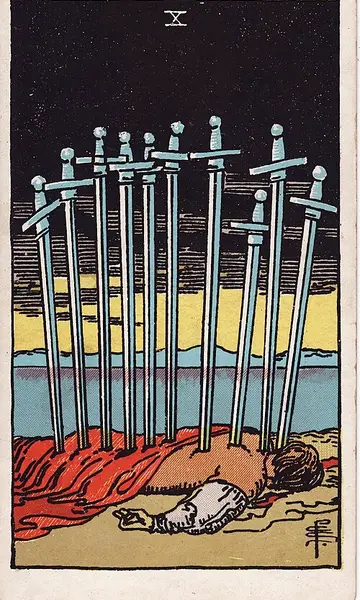
In an upright reading, the Ten of Swords speaks to collapse, betrayal, and reaching rock bottom. It represents an experience where an issue has been pushed as far as it can possibly go. Arthur Edward Waite described this card through terms of pain, affliction, tears, sadness, and desolation, while explicitly clarifying that it is not especially a card of violent death.
When this card appears, it asks for honest acknowledgment that a situation is truly over. There is no longer any reason to fight or strategize, because the conflict has run its course. Because you have touched bottom, nothing worse can follow; the only way left to go is up. The advice of the card is simple: accept that it is over, because the dawn is already rising.
What does the Ten of Swords mean reversed?
When reversed, the Ten of Swords indicates that recovery begins. It signifies survival, picking yourself up, and taking the first tentative steps toward healing. The storm has cleared, and you are beginning to put distance between yourself and the lowest point.
Alternatively, a reversed Ten of Swords can point to an unwillingness to accept the ending. It can reflect clinging to the wound, replaying the pain, or refusing to let go of what has already fallen apart. Waite noted associations with advantage, profit, success, and favour—though none of these are lasting—as well as power and authority. If you are recovering, remember to get up slowly and give yourself time to rebuild.
How does the Ten of Swords apply to love and relationships?
In readings about love, the Ten of Swords signifies a painful finish. It points to a relationship, a connection, or a repetitive emotional pattern that has reached an absolute end.
This card does not sugarcoat heartbreak or the sting of disappointment. However, it does bring finality. By acknowledging that a dynamic is no longer viable, you free yourself from prolonged uncertainty and create space for future emotional recovery.
How does the Ten of Swords interpret work and finances?
In career inquiries, the Ten of Swords represents a plan ruined or the end of a professional cycle. A project may have collapsed, an initiative might have failed, or a role may have reached an abrupt conclusion. While disappointing, this card clarifies that pouring more energy into a defunct plan will not revive it.
Financially, the card indicates reaching a bottom, absorbing losses, or dealing with a ruined financial venture. When reversed, it signals that the bleeding has stopped and the start of financial recovery is underway. Take practical stock of where things stand and begin rebuilding from solid ground.
Does the Ten of Swords mean yes or no?
The Ten of Swords reads as a no. It suggests that the path you are asking about has reached an insurmountable roadblock or that the current venture has concluded.
What is pictured on the card and why?
In the Rider–Waite–Smith tradition, published in 1909, the card shows a man lying face down on a desolate shore with ten swords embedded in his back. Above him, a heavy black sky begins to break, revealing a clear yellow dawn over calm, still water.
Every element in this scene reinforces the concept of reaching the absolute limit. The ten swords represent the heavy accumulation of mental stress, conflict, and painful realizations. The calm water reflects peace after the storm, while the golden dawn signifies the new day that naturally begins once the worst is finally over.
What do the number and suit reveal about this card?
In tarot numerology, the Tens represent completion, the end of a cycle, and the seed of a new one beginning. They show an energy pushed to its absolute maximum limit, where it must transition into something new.
As part of the suit of Swords, this card belongs to the domain of thoughts, communication, conflict, and decisions. The Ten of Swords shows what happens when intellectual tension, overthinking, or interpersonal conflict reaches total exhaustion. The mind can no longer carry the dispute, bringing an end to the mental battle.
What are the astrological and esoteric correspondences of the Ten of Swords?
In the esoteric system of the Hermetic Order of the Golden Dawn, the suit of Swords corresponds to the element of Air.
According to the Golden Dawn’s Book T, the Ten of Swords is titled the “Lord of Ruin.” Its astrological attribution is the Sun in Gemini. This decan pairing unites the illuminating, vital clarity of the Sun with Gemini’s quick, communicative Air energy, highlighting a moment where total mental clarity cuts through denial and brings an unavoidable finish.
Which cards strengthen or change the Ten of Swords?
The Ten of Swords connects closely with the card that precedes it:
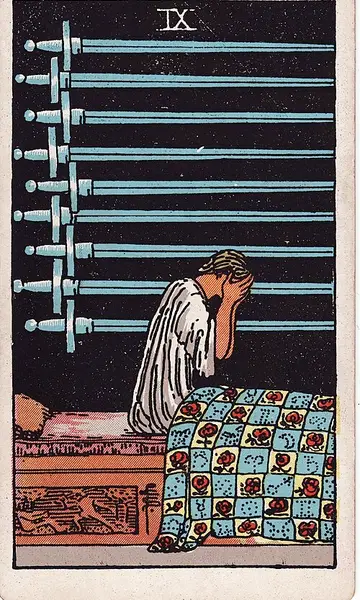
- Nine of Swords + Ten of Swords: This pairing represents the worst night followed by the break of dawn. While the Nine of Swords reflects acute worry, sleepless nights, and mental anguish, the Ten of Swords brings that anticipatory dread to a conclusive end. The painful event is no longer looming; it has occurred, and the healing light of morning can now follow.
What are common mistakes when reading the Ten of Swords?
A frequent error is interpreting the dramatic imagery as a prediction of literal physical death. In practice, the Ten of Swords is rarely literal death; as Waite explicitly stated, it is not especially a card of violent death.
Another common mistake is treating the card as entirely hopeless. While it reflects sadness and collapse, it is fundamentally about the end of the worst. It assures you that the downward slide has halted and the lowest point is behind you.