In tarot, Temperance represents moderation, blending, and patient healing. As Major Arcanum 14, it stands for a turning point and a big life theme that goes beyond the everyday: the conscious practice of bringing opposites into harmony, finding the middle path, and allowing personal integration to unfold at its natural pace. Far from passive waiting, Temperance is the active art of balance.
What does Temperance mean upright?
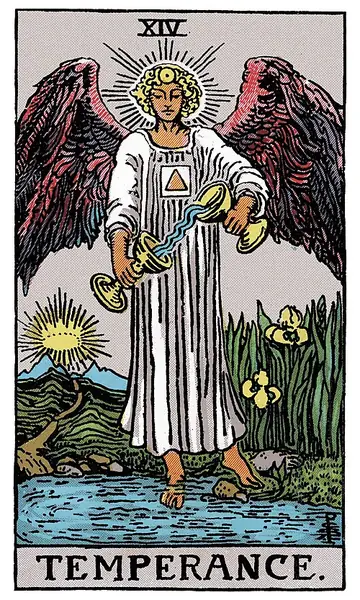
Upright, Temperance indicates that balance has been achieved or is being cultivated through patience, steady cooperation, and moderation. In the Rider–Waite–Smith tradition, published in 1909, Arthur Edward Waite associated this card with economy, frugality, management, and accommodation. Rather than swinging between sharp extremes, you are encouraged to walk the middle way.
This card represents active alchemy. Resolution and recovery rarely arrive through sudden, dramatic actions; they emerge from finding the right mix. By making small, steady adjustments, you allow the different areas of your life to settle into place. Temperance asks you to blend thoughts, emotions, and practical efforts into a peaceful, sustainable whole.
What does Temperance mean reversed?
When reversed, Temperance signals that the blend has tipped out of proportion. Excess, imbalance, or impatience may have taken over. You might be pushing too hard for immediate results, taking things to extremes, or attempting to force elements together that do not currently combine.
Waite described the reversed card in terms of disunion, unfortunate combinations, competing interests, and quarrels among factions or sects. In personal reflection, it points to inner friction, clashing priorities, or partners who struggle to work together. The advice here is clear: stop adding fuel to the situation, step back, and restore proper measure before taking another step.
How does Temperance speak to love?
A harmonious blend that needs patience is the core message of Temperance in love. A lasting relationship does not require giving up your individuality; it requires discovering how two distinct personalities, emotional rhythms, and perspectives can flow together without unnecessary friction.
If you encounter friction with someone, Temperance advises thoughtful compromise rather than rigid demands. Give the bond room to breathe and heal. When reversed, this card often highlights impatience, clashing interests, or emotional excess disrupting the connection, inviting you to re-establish calm and realistic expectations.
What does Temperance mean at work and with money?
At work, Temperance reflects compromise and steady integration. It favors collaborative environments that rely on diplomacy, mutual respect, and bringing together diverse skill sets. Forcing an outcome or rushing a deadline will only create resistance, while steady, consistent cooperation leads to long-term success.
With money, Temperance encourages moderate, balanced spending and saving. It calls for mindful financial management rather than alternating between reckless spending and fearful restriction. Reversed, it points toward financial excess, impulsive decisions, or mismatched expectations in business agreements.
Is Temperance a yes or a no?
In a direct question, Temperance reads as a yes. Its affirmative answer is grounded in patience, moderation, and a willingness to find the middle ground rather than seeking hasty, aggressive solutions.
What is pictured on the card and why?
In the Rider–Waite–Smith deck, Temperance features a winged angel standing between land and water, resting one foot on the earth and the other in a pool. This posture illustrates the essential balance between practical, grounded action and intuitive, emotional awareness.
The angel pours water steadily between two cups, symbolizing the patient alchemy of blending opposites into a higher unity. Along the water’s edge, blooming irises evoke a rainbow after a storm, signifying hope and emotional renewal. In the background, a winding path leads past green hills toward a radiant crown of light above the mountains, showing that patient, balanced living gradually guides you toward greater clarity.
What are the esoteric correspondences of Temperance?
In the Golden Dawn system, Temperance is attributed to the astrological sign Sagittarius. The card’s element is Fire, which is a modern convention derived directly from the Golden Dawn attribution of Sagittarius as a fire sign, used to evaluate elemental dignities between cards in a spread. While the imagery focuses on flowing water, the underlying Fire represents spiritual aspiration and the inner warmth necessary for personal transformation.
The formal Golden Dawn title of Temperance is “The Daughter of the Reconcilers; the Bringer-forth of Life.” On the Kabbalistic Tree of Life, it corresponds to Path 25, which connects Tiphareth (the center of harmony and consciousness) with Yesod (the foundation of the subconscious and astral realm). Its Hebrew letter is Samekh, meaning “prop” or support, representing the sturdy foundation that sustains balance.
Which cards interact with Temperance?
A key dynamic occurs when Temperance appears alongside The Devil. Together, Temperance and The Devil highlight moderation versus excess, pointing to a struggle with addiction, compulsion, or rigid extremes. While The Devil reveals unhealthy attachments and overindulgence, Temperance offers the antidote: self-restraint, patient healing, and the restoration of a healthy measure.
What are common mistakes when reading Temperance?
A frequent misreading is assuming Temperance represents passivity, inertia, or sheer boredom. Temperance is not inaction; it is an active, demanding alchemy that consciously holds competing energies in balance and blends them with care.
Another mistake is narrowing the card down only to physical abstinence from food or alcohol. While moderation in physical habits is part of its realm, Temperance addresses every area of life, including managing emotional extremes, balancing work and rest, and choosing your words with care.
Try it yourself
To explore how Temperance applies to your current situation, you can ask the bot questions such as: